What Am I Missing If I Only Eat Muscle Meat? The Other Half
What am I missing if I only eat muscle meat? Discover the essential nutrients like retinol, choline, and CoQ10 you're lacking—and how to fix it today.


It's 3pm on a Tuesday. You had eggs for breakfast, chicken and rice for lunch, and there's a ribeye thawing on the counter for tonight. Protein is dialed. You're doing the thing every men's health article told you to do.
And you're staring at the same email you opened forty minutes ago, wondering why your brain feels like it's running through wet sand.
You tell yourself you're eating clean. You are eating clean. That's the part that's confusing.
Here's the reframe that took me too long to find: if you're asking what am I missing if I only eat muscle meat, the answer is the half of the animal your great-grandfather ate by default and you've never once put on a plate.
The Ribeye Trap
Walk through any American grocery store meat aisle. Shrink-wrapped muscle. Ground chuck, sirloin, chicken breast, pork loin. That's what "meat" means to us now. Boneless, organ-free, hyper-convenient.
Our great-grandfathers didn't eat like that. Meat was expensive, and throwing away half the animal was a stupid rich-guy move. Liver got eaten. Heart got eaten. Kidney went into pies. The whole beast fed the family because the whole beast had a job.
We kept the muscle. We threw the rest away. Nobody explained what we were losing when we did that.
The 3pm wall you feel? That's a real, measurable mid-afternoon dip in alertness that shows up even on days you skip lunch, so it isn't the sandwich, it's your circadian clock talking [1]. It hits harder when the tank is thin.
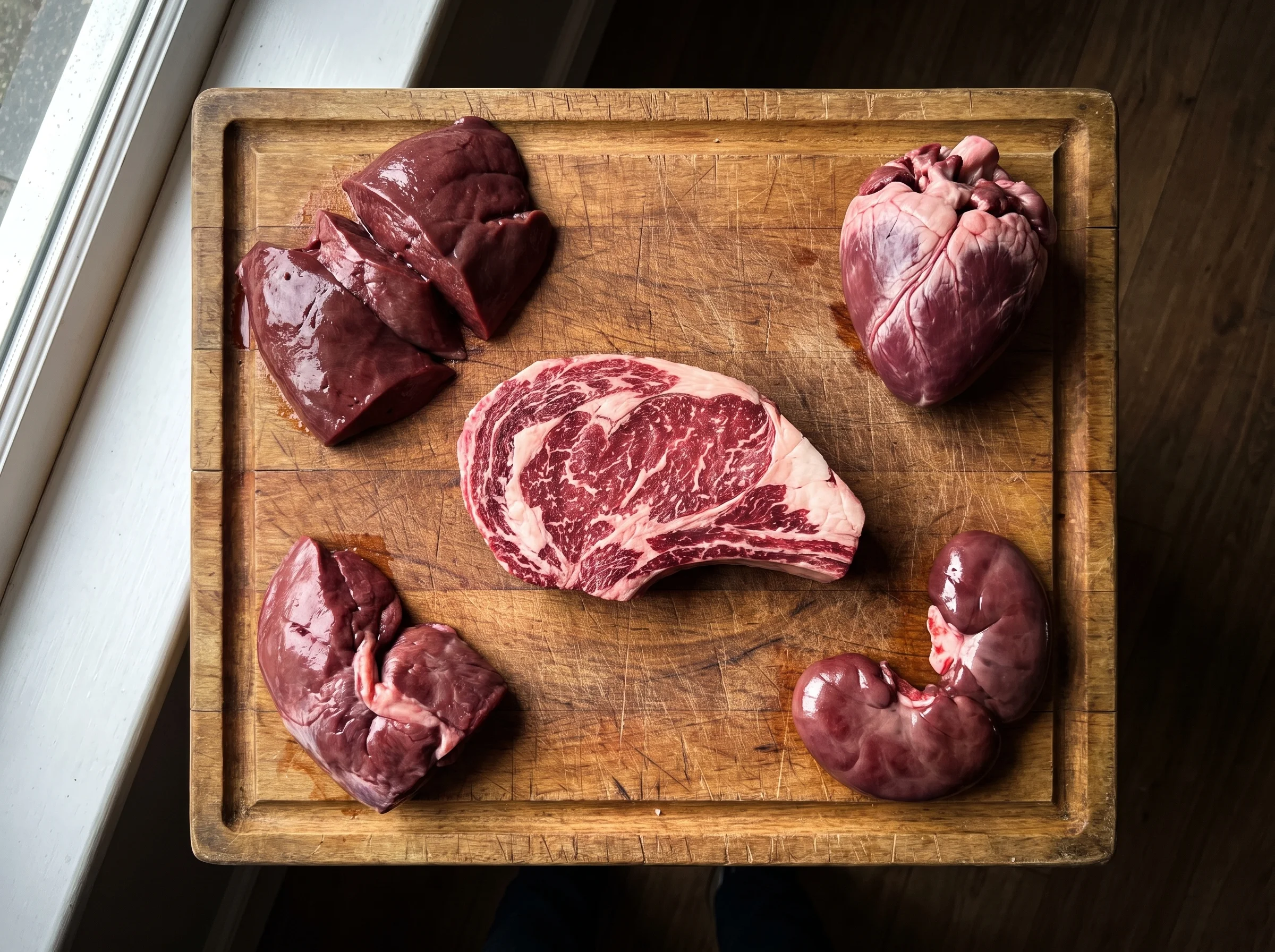
Think of it this way. Eating only muscle meat is like buying a truck and only using the engine block. The engine is powerful. It still needs oil, coolant, spark plugs, and a battery to actually move. Muscle meat is the engine. Organs are the rest of the system.
What Muscle Meat Delivers, and Where It Stops
Let me be clear before we go further: muscle meat is not the villain. Steak is real food. A ribeye gives you complete protein, creatine, heme iron, B vitamins, and the amino acids that build a middle-aged body back up when you lift.
I'm not asking you to give up steak. I'd fight you for the last one.
But here's where muscle meat thins out:
- Preformed vitamin A (retinol), the direct usable form, sits in liver at concentrations muscle can't touch [2].
- Choline, an essential nutrient men are especially bad at getting, is packed into liver at roughly 330 mg per 100 g [3].
- CoQ10, the compound that sits inside your cellular energy machinery, concentrates in heart tissue at levels muscle doesn't approach [4].
- Copper, folate, B12 density, riboflavin, all disproportionately high in liver [5, 6].
- Selenium, which the thyroid holds more of than any other organ, is notably concentrated in kidney [6, 7].
At 47 I was eating over 200 grams of protein a day. Grilled chicken, ground beef, ribeye on the weekends, eggs by the dozen. Clean-ish. And I still felt like a dim bulb by 3pm. My labs came back "normal for a 49 year old American male," which I later realized is a low bar I flat refused to clear.
Muscle meat wasn't wrong. It was incomplete.
The Cofactor Story: Why Muscle Meat Alone Falls Short
Here's the piece nobody explained to me, and it's the shift that changed how I ate.
Protein is bricks. Cofactors are mortar. You can stack bricks in a pile all day. Without mortar, you don't have a wall.
Choline is essential. Under severe restriction, 77 percent of men in a controlled study developed reversible signs of liver or muscle dysfunction, which is a polite way of saying your body actually needs the stuff to run [8]. Men are especially vulnerable because we don't get the estrogen-driven flexibility women have to make their own.
Vitamin A from carrots and sweet potatoes has to be converted from beta-carotene into retinol, and the conversion rate ranges wildly from person to person, somewhere between 4:1 and 28:1 by weight [9]. If you're a poor converter, you can eat a garden and still run low. Liver skips the whole conversion problem and hands you retinol directly.
CoQ10 lives in the mitochondrial machinery your cells use to make ATP, which is the energy currency that runs everything from your heart to your morning thinking [10]. And the cellular machinery that makes energy actually slows down with age. In adults 18 to 89, skeletal-muscle ATP production fell about 8 percent per decade [11].
Read that again. Every ten years, your energy factory loses about 8 percent of its output. Food quality matters more as you age, not less.
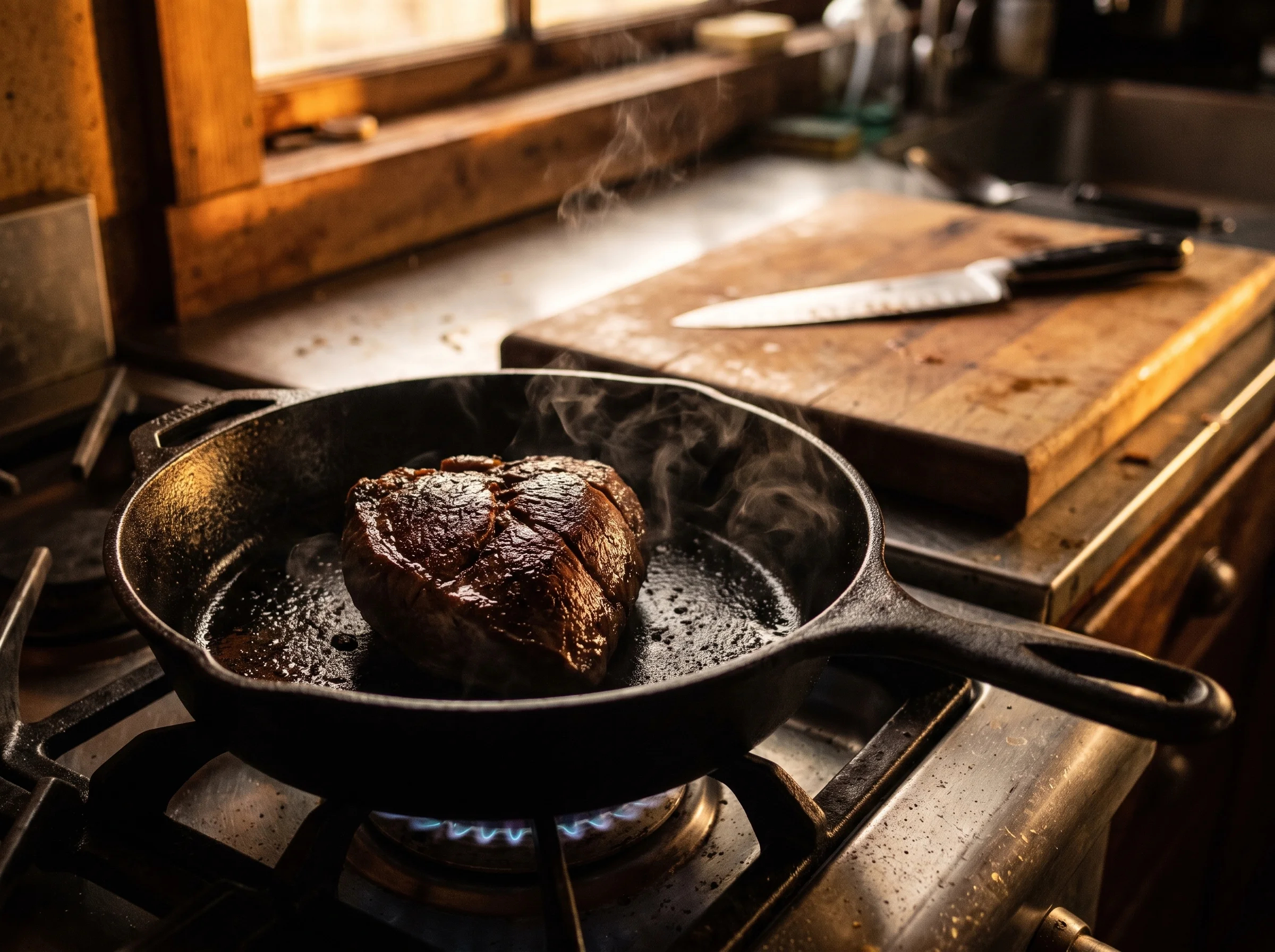
Your steak gives you the raw materials. The organs deliver the tools that actually build with them. You've been showing up to the job site with lumber and no hammer for a decade.
The Slow Leak
This isn't the kind of deficiency that puts you in the ER. It's subclinical drift. You don't wake up one Tuesday with scurvy. You wake up one Tuesday realizing you haven't felt like yourself in five years.
Testosterone falls gradually and progressively with age in healthy men [12]. That's the baseline slope. Then stack real life on top of it: five to six hours of sleep instead of seven or eight can knock daytime testosterone 10 to 15 percent in a week in young men [13], and poor sleep raises baseline cortisol so your stress response runs hotter all day [14].
Now add thin raw materials. Your machinery is slowing, your sleep is short, your stress is up, and the cofactors that would help your body do repair work aren't showing up on the plate.
That's not "just aging." That's running on half rations for a decade and calling the result normal.

Even the guys who do eat organs the traditional way lose a chunk of the value in the pan. Broiled liver loses about 41 percent of its folate. Frying loses about 50 percent [15]. Frying beef heart drops recoverable CoQ10 to roughly 69 percent [4]. Heat is not friendly to the fragile stuff.
Why "Just Eat Liver" Doesn't Work
Here's where every ancestral-eating article loses me.
The obvious answer is: eat liver once a week. Cool. You won't.
Liver tastes like it lost a fight. Kidney smells like something died in the sink. Heart is chewy in a way that makes your jaw tired. There is not enough ketchup, onion, or bacon fat in the world to make me put pan-fried liver on my family's plate on a Wednesday night.
I tried. Read a book that told me to. Bought grass-fed liver from a good butcher. Cooked it three weeks in a row. My wife hated the smell so much she started leaving the kitchen. My kids picked at their sides and asked what was wrong with the meat. I quit.
Then I defaulted to a multivitamin, which is synthetic isolates in a matrix your body was never designed to recognize, and I felt no different.
That's why the Savage Beef Organ Stack exists, and I'll be honest with you, it's why I take it. Six organs, liver, heart, kidney, testicle, prostate, pituitary, freeze-dried raw, three capsules with breakfast. Freeze-drying avoids the sustained heat that documented cooking losses come from [16, 17]. I'm not going to tell you it locks in 100 percent of anything. I'll tell you it dodges the pan losses and it gets the organ profile into a guy who is never, ever going to blend raw liver into a smoothie.
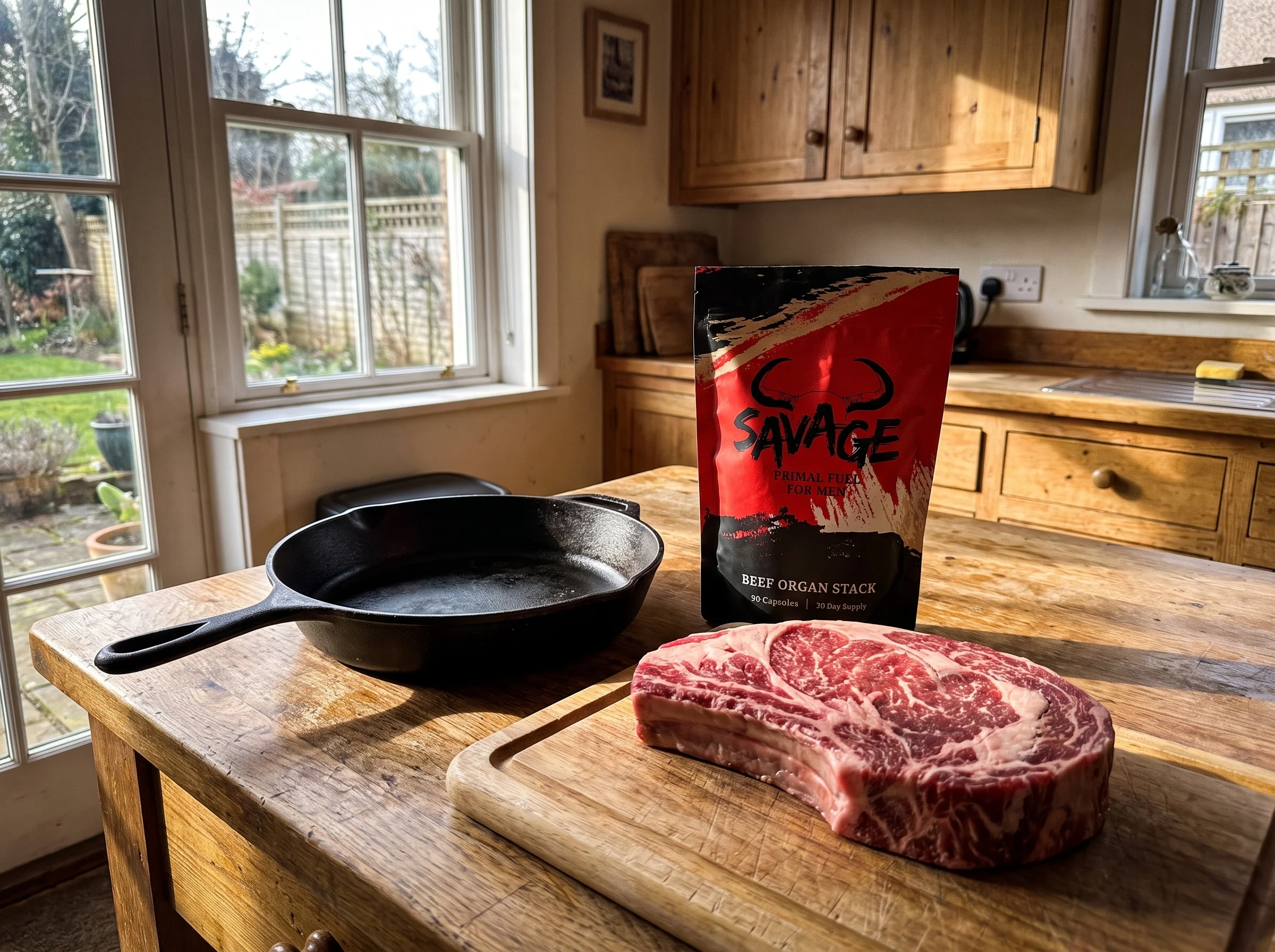
That's the whole pitch. The organs are extraordinary. They're also unpleasant. The pouch closes the gap.
The Practical Plate: What to Eat If Muscle Meat Isn't Enough
If you read this and nod, here's what you do Monday morning.
Keep the steak. Protein target for a healthy older guy is roughly 1.0 to 1.2 g/kg/day, more if you're active, and the muscle-building benefit of protein plus resistance training plateaus around 1.6 g/kg/day [18, 19]. Muscle meat is the workhorse here. Don't ditch it.
Add the missing half.
- Ideal world: liver once a week if you can stomach it, heart when your butcher has it, eggs daily, real bone broth.
- Real world: get the organ profile into your day in a way you'll actually do 30 days in a row.
Lift heavy. Testosterone is a major driver of muscle growth and rises acutely after heavy resistance work [20]. Your body responds to load.
Sleep seven to eight hours. No capsule, no steak, no organ stack fixes short sleep [13, 14]. This is the foundation. Everything else is decoration if you're sleeping five.
The Stack, for me and the men I coach, is the convenient daily floor. It means on the week I didn't get to the butcher, the whole-animal profile still showed up. That's it. It's not magic. It's just the other half of the meal my great-grandfather ate without thinking.
Quick note before I close: if you've ever been told your ferritin is high, or you have haemochromatosis in the family, talk to your doctor before adding an iron-containing organ product. Organ iron is a mix of heme and non-heme and it's real food iron, so honor that.
The Takeaway
You are not eating wrong. You are eating half the animal.
The half you're missing carries the cofactors that make the half you're eating actually work in a 50-year-old body. That's the whole story. That's why the 3pm wall keeps coming and the mirror keeps softening and your labs keep coming back "fine."
You don't need TRT. You don't need another cardio phase. You don't need a multivitamin with fairy dust. You need the other half of what your great-grandfather ate by default.
Keep the ribeye. Add the rest of the animal. Watch what comes back.
References
[1] Monk TH. The Post-Lunch Dip in Performance. Clin Sports Med. 2005;24(2):e15-e23. https://pubmed.ncbi.nlm.nih.gov/15892914/
[2] NIH Office of Dietary Supplements. Vitamin A and Carotenoids Fact Sheet for Health Professionals. https://ods.od.nih.gov/factsheets/VitaminA-HealthProfessional/
[3] USDA Database for the Choline Content of Common Foods, Release 2 (2008). https://www.ars.usda.gov/ARSUserFiles/80400525/data/choline/choln02.pdf
[4] Ercan P, El SN. Coenzyme Q10 content of beef heart and cooking effects. J Food Compost Anal. 2011;24(8):1136-1140. https://www.sciencedirect.com/science/article/pii/S0889157511001517
[5] Fuerniss HF, et al. Nutrient Analysis of Raw United States Beef Offal Items. Nutrients. 2024;16(18):3104. https://pubmed.ncbi.nlm.nih.gov/39339704/
[6] USDA FoodData Central. Beef liver 169451, heart 168625, kidney 169449. https://fdc.nal.usda.gov/food-details/169451/nutrients
[7] NIH Office of Dietary Supplements. Selenium Fact Sheet for Health Professionals. https://ods.od.nih.gov/factsheets/Selenium-HealthProfessional/
[8] Fischer LM, et al. Sex and menopausal status influence human dietary requirements for the nutrient choline. Am J Clin Nutr. 2007;85(5):1275-1285. https://pubmed.ncbi.nlm.nih.gov/17490963/
[9] Tang G. Bioconversion of dietary provitamin A carotenoids to vitamin A in humans. Am J Clin Nutr. 2010;91(5):1468S-1473S. https://pubmed.ncbi.nlm.nih.gov/20200262/
[10] Diaz-Casado ME, et al. The Paradox of Coenzyme Q10 in Aging. Nutrients. 2019;11(9):2221. https://pmc.ncbi.nlm.nih.gov/articles/PMC6770889/
[11] Short KR, et al. Decline in skeletal muscle mitochondrial function with aging in humans. PNAS. 2005;102(15):5618-5623. https://pubmed.ncbi.nlm.nih.gov/15800038/
[12] Harman SM, et al. Longitudinal Effects of Aging on Serum Total and Free Testosterone Levels in Healthy Men (Baltimore Longitudinal Study of Aging). J Clin Endocrinol Metab. 2001;86(2):724-731. https://academic.oup.com/jcem/article/86/2/724/2841070
[13] Leproult R, Van Cauter E. Effect of 1 Week of Sleep Restriction on Testosterone Levels in Young Healthy Men. JAMA. 2011;305(21):2173-2174. https://jamanetwork.com/journals/jama/fullarticle/1029127
[14] Minkel J, et al. Sleep deprivation potentiates HPA axis stress reactivity in healthy adults. Health Psychol. 2014;33(11):1430-1434. https://pubmed.ncbi.nlm.nih.gov/24818608/
[15] Aramouni FM, Godber JS. Folate losses in beef liver due to cooking and frozen storage. J Food Qual. 1991;14(5):357-365. https://onlinelibrary.wiley.com/doi/10.1111/j.1745-4557.1991.tb00077.x
[16] Ratti C. Hot air and freeze-drying of high-value foods: a review. J Food Eng. 2001;49(4):311-319. https://www.sciencedirect.com/science/article/pii/S0260877400002284
[17] Juknienė I, et al. Lyophilization retention of composition in animal offal. Appl Sci. 2022;12(24):12984. https://www.mdpi.com/2076-3417/12/24/12984
[18] Morton RW, et al. A systematic review, meta-analysis and meta-regression of the effect of protein supplementation on resistance training-induced gains in muscle mass and strength in healthy adults. Br J Sports Med. 2018;52(6):376-384. https://pubmed.ncbi.nlm.nih.gov/28698222/
[19] Bauer J, et al. Evidence-based recommendations for optimal dietary protein intake in older people: a position paper from the PROT-AGE Study Group. J Am Med Dir Assoc. 2013;14(8):542-559. https://pubmed.ncbi.nlm.nih.gov/23867520/
[20] Vingren JL, et al. Testosterone Physiology in Resistance Exercise and Training. Sports Med. 2010;40(12):1037-1053. https://link.springer.com/article/10.2165/11536910-000000000-00000