Used to be the strong guy now I'm not: What changed
Used to be the strong guy now I'm not? You didn't lose strength—you lost recovery. Discover what actually broke and how to fix it starting today.


The Freezer Moment
Last spring my brother-in-law asked me to help him move a chest freezer out of his garage. Twenty years ago I would have grabbed the heavy end without looking. That day I looked. I picked the lighter end and I hoped he did not notice.
You know that moment? Different object, same feeling. The couch at your buddy's place. The bag of mulch at the register. The suitcase your daughter hands you at the airport. Somewhere between 42 and 50, a switch flipped and nobody sent you the memo.
I am not talking about a bad set at the gym. I am talking about the quiet grief of standing next to a younger guy who is doing easily what you used to do without thinking. And then the voice in your head goes, when did that happen? If you used to be the strong guy and now you're not, this is for you.
The world will tell you it is "just aging." I refuse to accept that as the whole story, and by the end of this you will see why.
You Did Not Lose Strength. You Lost Recovery.
Here is the shift that changed everything for me.
The strong guy is still in the wiring. The lift you did at 35 is still in there. What actually broke is not the muscle. It is the recovery machinery that used to rebuild you overnight while you slept off a pizza and four hours in bed.
At 35 you could grind through a bad week and hit your numbers Monday. At 50, that same week costs you a month. So you train a little less. So you get a little weaker. So the next lift feels harder. That is the cascade, and almost nobody names it.
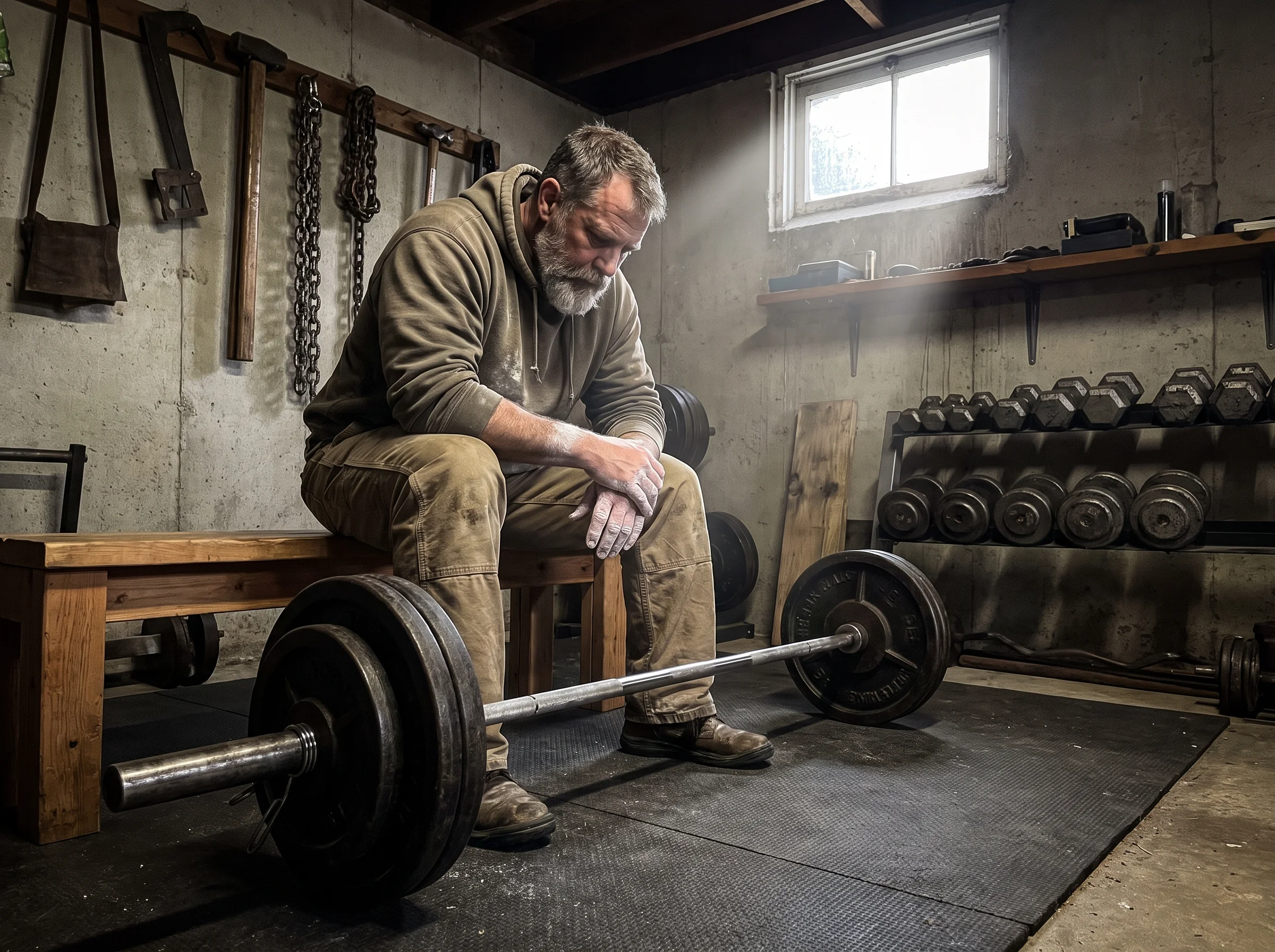
Think of your body like a checking account. At 35 you had steady deposits (deep sleep, dense food, a hormonal environment on your side) and normal withdrawals (workouts, stress, work, kids). At 50 the deposits shrank and the withdrawals stayed the same. You are not overdrawn because you spent more. You are overdrawn because the deposits stopped clearing.
That is not vibes. In a study of adults from 18 to 89, skeletal-muscle mitochondrial ATP production dropped about 8 percent per decade [1]. Plain English: the little engines in your muscle cells that turn food into force change with age. Measurable. Documented. Not in your head.
Belief number one, confirmed. This is real.
The Two Things That Actually Broke
Two big deposits stopped clearing. Sleep and food quality. Everything else is downstream.
Brick 1: Sleep got shorter, and the whole system paid
Most of the men I talk to are living on five to six hours a night. They think it is fine. It is not fine.
In young healthy men, one week of about five hours of sleep dropped daytime testosterone by 10 to 15 percent [2]. That was young men. Read that twice.
Sleep-deprived adults also show higher baseline cortisol and a bigger cortisol response to a stressor [3]. Cortisol is the withdrawal ticket your body writes when it thinks it is under attack. When it stays up, recovery goes down.

Short sleep is not just tiredness. It shifts the entire hormonal weather system your recovery runs on. No capsule fixes that. Sleep is the foundation. Get that right or nothing else matters.
Brick 2: The plate stopped delivering the parts that feed recovery
Look at what the average American man eats in a week. Muscle meat, refined carbs, seed oils, coffee, protein shake, repeat. Not terrible. Not the disaster the internet says it is. Just thin.
Thin in the specific micronutrients that our great-grandfathers got by default because they ate the whole animal. The parts we now throw away or feed to the dog.
A 2024 analysis of raw United States beef offal confirmed that liver, heart, and kidney carry distinct, concentrated micronutrient loads [4]. USDA data says the same [5]. Liver is loaded with preformed vitamin A, B12, folate, copper, riboflavin, iron, and choline. Heart carries CoQ10. Kidney is notably high in selenium.
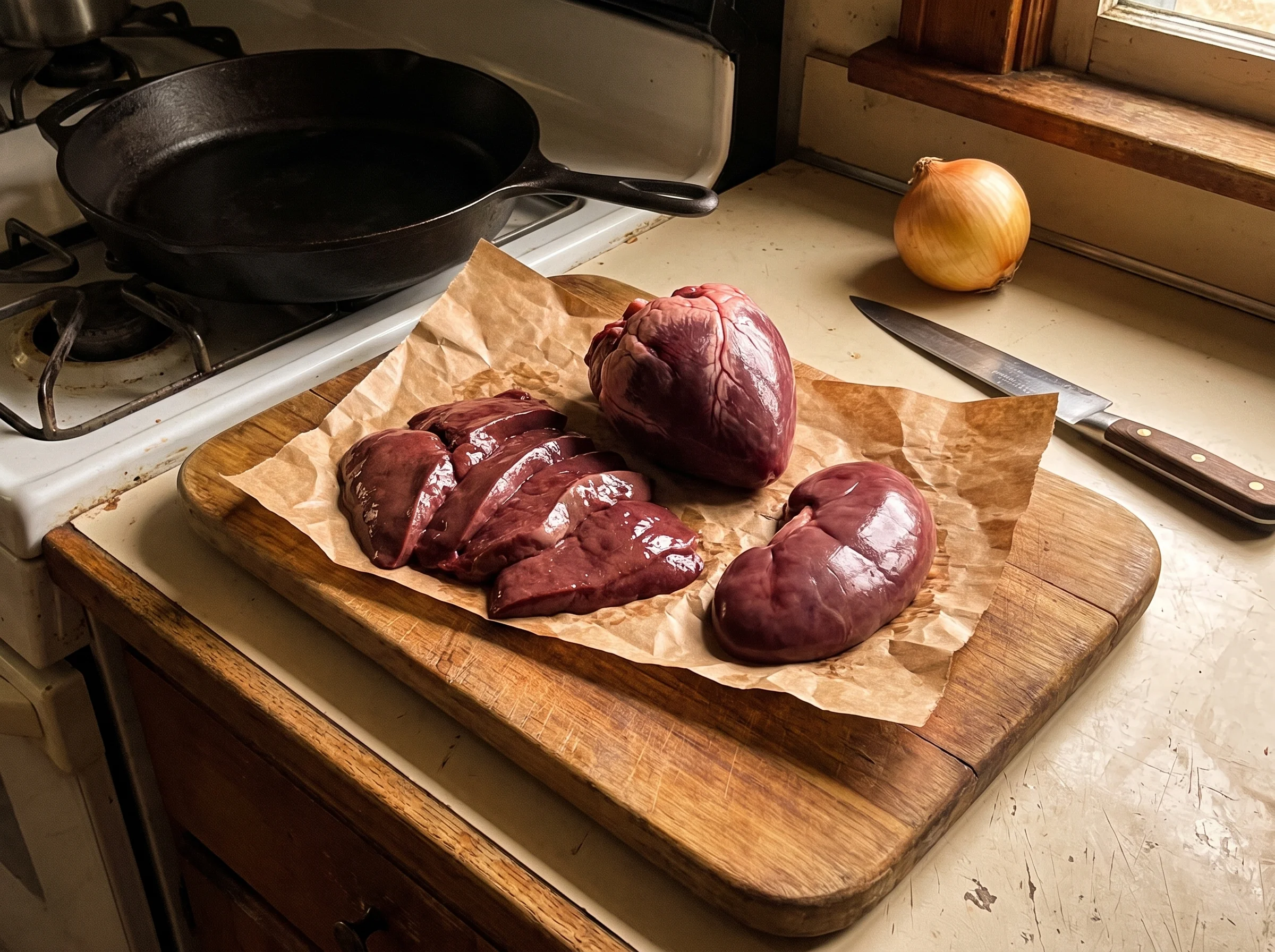
Take CoQ10 alone. It sits inside the mitochondrial inner membrane and links metabolic pathways to ATP production [6]. Think of CoQ10 like the spark plug in the cellular engine. Your heart muscle holds among the highest levels of it in your body for a reason: it never stops working. Raw beef heart carries about 11 mg of CoQ10 per 100 grams, and frying it cuts recoverable CoQ10 to roughly 69 percent [7]. Cook the heart and you throw some of the spark plug into the pan.
Or choline. Raw beef liver carries roughly 330 mg of total choline per 100 grams [8]. Choline is essential, and men are especially vulnerable to running low: under severe choline restriction, 77 percent of men developed reversible signs of liver or muscle dysfunction [9]. Muscle dysfunction. Read that word again if you lift.
Or vitamin A. Converting plant beta-carotene to retinol is inefficient and varies wildly from person to person, anywhere from 4:1 to 28:1 by weight [10]. Liver gives you preformed retinol directly. No conversion gamble.
I am not going to sit here and tell you the Stack fixes your soreness. I am going to lay the bricks and let you connect them.
Why What You Have Already Tried Did Not Work
I know because I tried them all.
More cardio. I ran more. I felt worse. I taxed the same recovery system that was already underwater. All I did was write bigger withdrawal tickets.
A T-booster off Amazon. No reliable evidence any of those meaningfully change testosterone in a man who is not deficient. I wasted a hundred bucks and a lot of hope.
Cutting carbs harder. Added stress, added grumpiness, did not touch the supply chain.
Straight to TRT. Not anti-medicine. Pro-ownership. TRT can mask the symptom without fixing the root, and it is a prescription you generally do not get off. I wanted my body back, not a monthly subscription to it.
Every one of those moves tried to change the withdrawal side of the account. None of them fixed the deposit side. That is why they did not work.
What Actually Moved The Needle
Three clean points. In this order. Skip the order and you will waste months.
1. Sleep seven hours, non-negotiable
Not a stretch goal. A floor. Set a bedtime alarm on your phone the way you set a wake alarm. For 14 nights. Do this before you change anything else, because no nutrient, no lift, no supplement compensates for short sleep. The cortisol data is clear on that [3].
2. Lift heavy, less often, and let recovery do its job
This is the counter-intuitive one. Most 50-year-olds trying to claw their edge back double their volume. That is the exact wrong move.
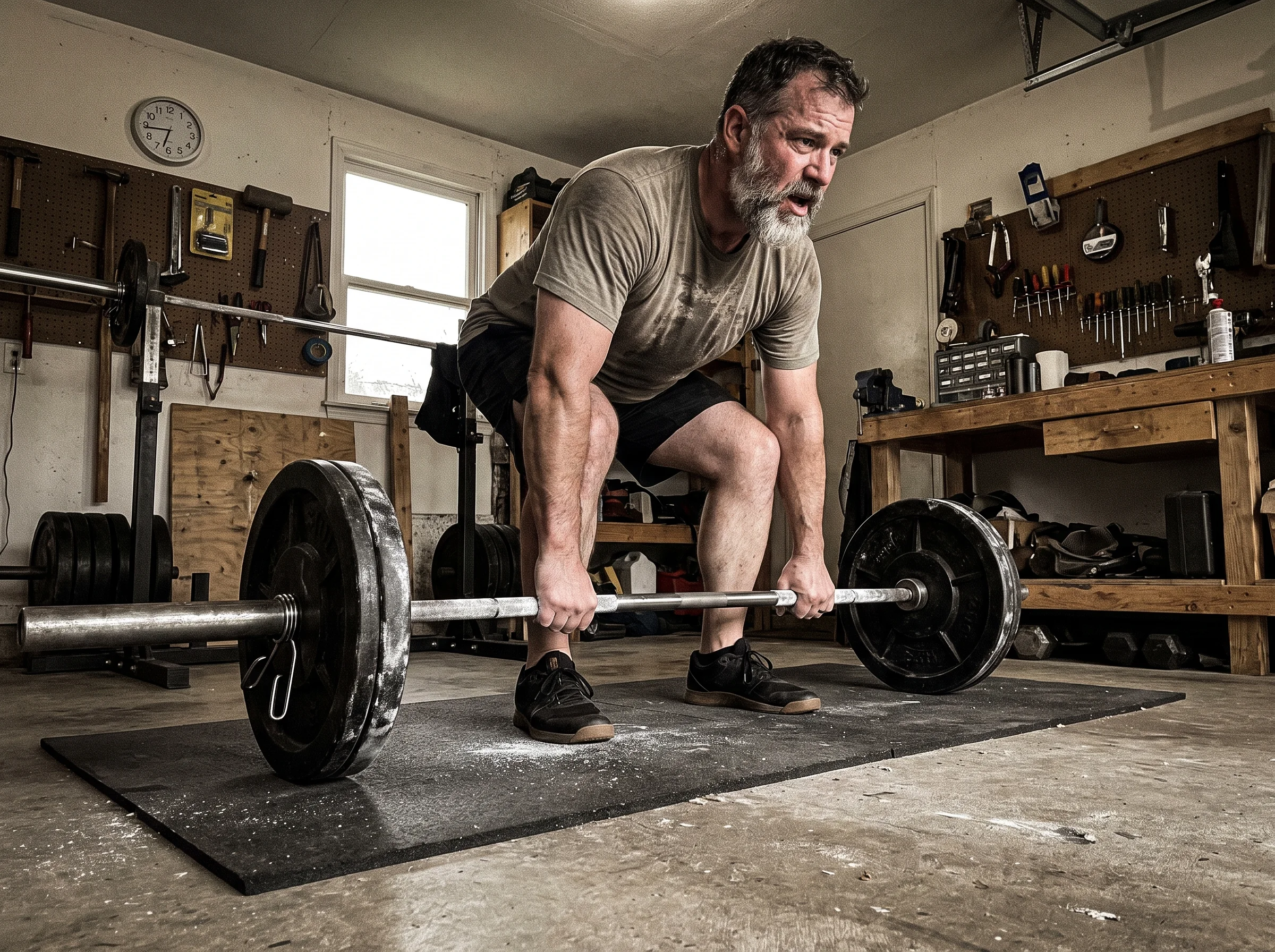
Two heavy sessions a week. Full recovery between them. Testosterone is a major promoter of muscle growth and strength, and it is acutely elevated after heavy resistance exercise in men [11]. Heavy is the input. Recovery is the output. You are not 25. You do not need five sessions. You need two clean ones and the rest of the week to actually rebuild.
Protein around 1.2 to 1.6 grams per kilogram of body weight per day matters more now than it did at 30 [12][13]. Real food. Meat and eggs, not shakes as a meal replacement.
3. Feed the machine the parts modern meals skipped
This is where I stopped being clever and started eating like my grandfather. Or at least trying to.
I tried. Liver once a week. My wife was patient. I was not. Liver is nature's multivitamin and it also tastes like it lost a fight. There is not enough onion and butter in the world to make me eat it three times a week for the rest of my life.
That is the honest reason I take the Savage Beef Organ Stack. Three capsules with breakfast. Six organs: liver, heart, kidney, testicle, prostate, pituitary. Freeze-dried raw, which avoids the sustained heat that hot-air drying uses and that we know degrades some of the compounds we care about [14][15]. No gag reflex. No shopping trip. No sad plate.
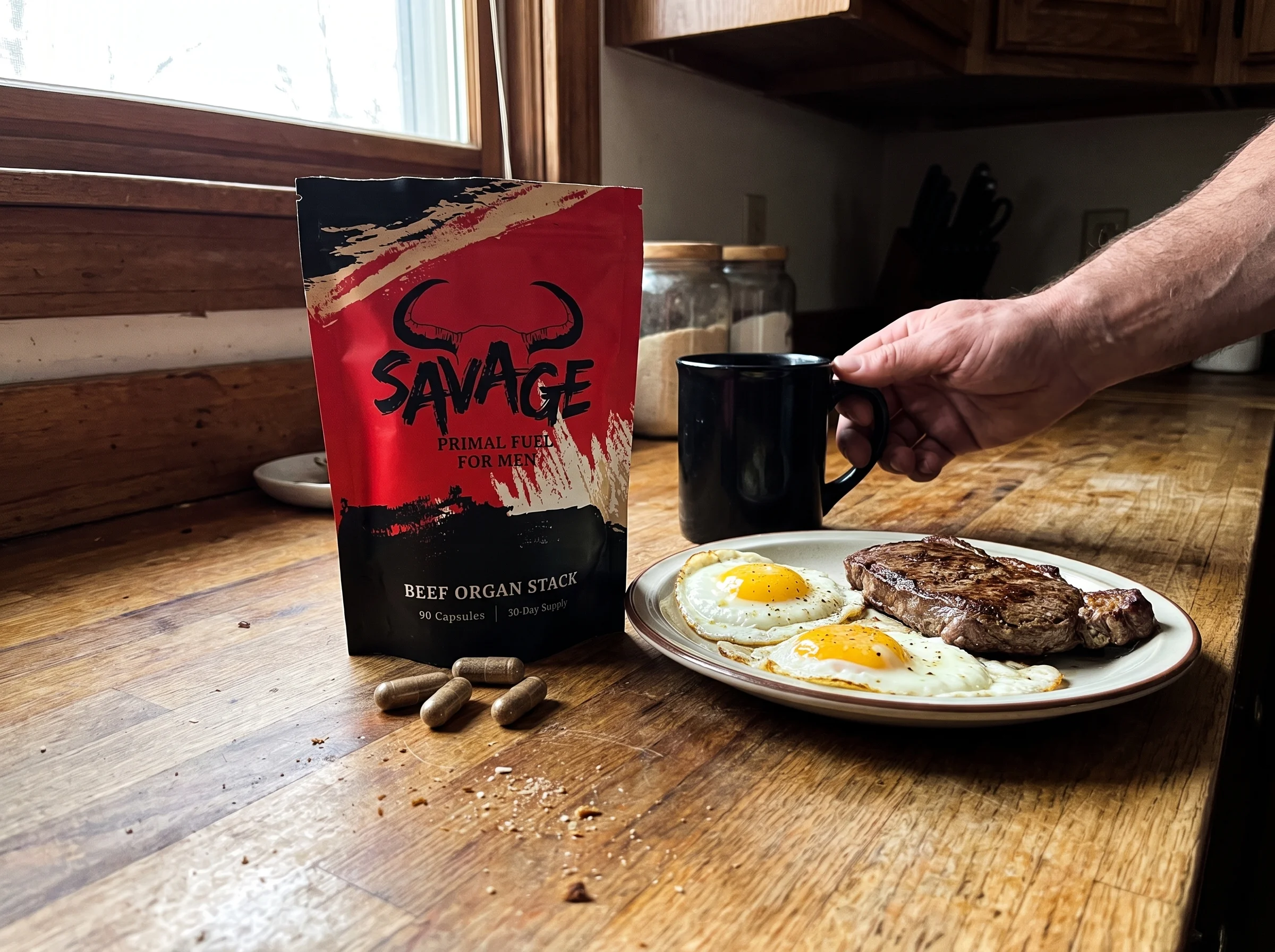
It is not magic. It is the closing of a specific micronutrient gap the modern plate leaves. That is the whole pitch. That is why I still take it after three years.
The Strong Guy Is Not Gone. He Is Under-Supplied.
Six months into fixing my sleep, my lifts, and my plate, my neighbor asked me to help him move a used treadmill up his basement stairs. I grabbed the heavy end. I did not think about it until I was back in my kitchen an hour later, drinking water, and my wife looked at me funny.
I am not 30. I am 51. I did not get 30 back. I got 51, actually supplied, and 51 supplied is a very different man than 51 running on fumes.
That is the direction. Not a promise. Not a timeline. A direction.
The freezer moment does not have to be the new normal. It is a signal that the deposits stopped clearing. Fix the deposits and the strong guy walks back into the room on his own.
Where To Start This Week
- Sleep seven hours for the next 14 nights. Track it.
- Two heavy lifts this week. Full recovery in between.
- Eat the whole animal. Or, if you are like me and you will not, take the Savage Beef Organ Stack. Three capsules with breakfast.
- Reassess in 60 days, not 60 hours.
You did not lose your strength. You lost your recovery. Feed the supply chain and see what shows up.
References
- Short KR, et al. Decline in skeletal muscle mitochondrial function with aging in humans. PNAS. 2005;102(15):5618-5623. https://pubmed.ncbi.nlm.nih.gov/15800038/
- Leproult R, Van Cauter E. Effect of 1 Week of Sleep Restriction on Testosterone Levels in Young Healthy Men. JAMA. 2011;305(21):2173-2174. https://jamanetwork.com/journals/jama/fullarticle/1029127
- Minkel J, et al. Sleep deprivation and stressors: Evidence for elevated negative affect in response to mild stressors when sleep deprived. Health Psychol. 2014;33(11):1430-1434. https://pubmed.ncbi.nlm.nih.gov/24818608/
- Fuerniss HF, et al. Nutrient Analysis of Raw United States Beef Offal Items. Nutrients. 2024;16(18):3104. https://pubmed.ncbi.nlm.nih.gov/39339704/
- USDA FoodData Central SR Legacy. Beef, variety meats and by-products, liver, raw (169451). https://fdc.nal.usda.gov/food-details/169451/nutrients
- Diaz-Casado ME, et al. The Paradox of Coenzyme Q10 in Aging. Nutrients. 2019;11(9):2221. https://pmc.ncbi.nlm.nih.gov/articles/PMC6770889/
- Ercan P, El SN. Changes in content of coenzyme Q10 in beef muscle, beef liver and beef heart with cooking and in vitro digestion. J Food Compost Anal. 2011;24(8):1136-1140. https://www.sciencedirect.com/science/article/pii/S0889157511001517
- USDA Database for the Choline Content of Common Foods, Release 2 (2008). https://www.ars.usda.gov/ARSUserFiles/80400525/data/choline/choln02.pdf
- Fischer LM, et al. Sex and menopausal status influence human dietary requirements for the nutrient choline. Am J Clin Nutr. 2007;85(5):1275-1285. https://pubmed.ncbi.nlm.nih.gov/17490963/
- Tang G. Bioconversion of dietary provitamin A carotenoids to vitamin A in humans. Am J Clin Nutr. 2010;91(5):1468S-1473S. https://pubmed.ncbi.nlm.nih.gov/20200262/
- Vingren JL, et al. Testosterone Physiology in Resistance Exercise and Training. Sports Med. 2010;40(12):1037-1053. https://link.springer.com/article/10.2165/11536910-000000000-00000
- Morton RW, et al. A systematic review, meta-analysis and meta-regression of the effect of protein supplementation on resistance training-induced gains in muscle mass and strength in healthy adults. Br J Sports Med. 2018;52(6):376-384. https://pubmed.ncbi.nlm.nih.gov/28698222/
- Bauer J, et al. Evidence-Based Recommendations for Optimal Dietary Protein Intake in Older People: A Position Paper From the PROT-AGE Study Group. J Am Med Dir Assoc. 2013;14(8):542-559. https://pubmed.ncbi.nlm.nih.gov/23867520/
- Ratti C. Hot air and freeze-drying of high-value foods: a review. J Food Eng. 2001;49(4):311-319. https://www.sciencedirect.com/science/article/pii/S0260877400002284
- Aramouni FM, Godber JS. Folate losses in beef liver due to cooking and frozen storage. J Food Qual. 1991;14(5):357-365. https://onlinelibrary.wiley.com/doi/10.1111/j.1745-4557.1991.tb00077.x