Why Your Energy Crashes at 3PM After 40 (The Real Fix)
Why your energy crashes at 3pm after 40 is not about lunch. It is three engines running low at once. Here is what actually moves the needle.


I did not fall off a cliff at 47. I leaked.
A little less energy every month. A little more coffee. A little more brain fog after lunch. Until one Tuesday at 3:14pm I put my head down on my desk in the middle of a workday and could not remember the last afternoon I actually felt sharp.
You know that feeling? The one where you are staring at your monitor, reading the same email for the third time, and your body is basically begging you to lie down on the office carpet?
That is not laziness. That is not your turkey sandwich. Something under the hood has changed, and most of the articles you have read about why your energy crashes at 3pm after 40 are telling you the wrong story.
Let me tell you what is actually happening.
The 3pm Crash Was Always Going to Happen. You Just Never Felt It Before.
Here is the first thing nobody explains: the afternoon dip is real, and it is baked into you. It is a circadian event, not a food coma. Researchers have studied this for decades. The post-lunch dip in alertness happens even when people skip lunch entirely [1]. Your body's internal clock produces a natural sleepiness bump in the mid-afternoon whether you ate or not.
So blaming your sandwich is like blaming the rooster for the sunrise.
Think of it this way. Your body has an internal tide. Every afternoon, the tide goes out. When you were 25, your reservoir was so full you never noticed the water level drop. You could power through, hit a coffee, go lift after work, close down a bar at midnight, and still function the next day.
At 47, the reservoir is lower. The same tide going out now drains you all the way to the mud.
The crash was always there. What changed is your ability to absorb it.
That reframe alone is worth the read. Because if you think the problem is lunch, you will keep chasing the wrong fix (skip carbs, drink more water, try intermittent fasting) and keep feeling like garbage. The problem is upstream.

What Actually Changed Under the Hood After 40
Three engines are running low at once. Not one. Three. And they feed each other, which is why nothing you have tried so far has really worked.
Engine 1: Your sleep is worse than you admit
The man reading this is sleeping 5 to 6 hours a night. That is the honest number. Maybe you tell yourself it is 7 because you were in bed for 7, but you were up at 2:40am staring at the ceiling for 45 minutes, and your smartwatch, if you actually looked at it, would tell you the truth.
Researchers at the University of Chicago restricted healthy young men to about 5 hours of sleep for one week. Their daytime testosterone dropped 10 to 15 percent [2]. One week. In young, healthy men.
You are not a young, healthy man. You are a 48-year-old with a mortgage, a kid who does not sleep either, and a resting cortisol level that has been elevated since the last recession. Whatever sleep debt does to a 25-year-old, it does worse to you.
Sleep is when the pit crew works on the car. It is when your body clears metabolic garbage, rebuilds tissue, and resets your hormones. Skip the pit stops and by lap 300 you are running on flat tires and a bent axle. You do not "get away with" bad sleep in your 40s the way you did in your 20s. It compounds.
Engine 2: Your hormones are quietly drifting down
Testosterone does not fall off a cliff for most men. It leaks. A long-term study out of Baltimore [3] tracked healthy men over years and found that total and free testosterone decline gradually and progressively with age. Nobody hands you a memo. There is no bad day. It is just a slow, quiet drift downward.
At 3pm, what does that feel like? Less drive. Less recovery from the morning. Less buffer against the tide going out. Your body has less horsepower to spend on the second half of the day.
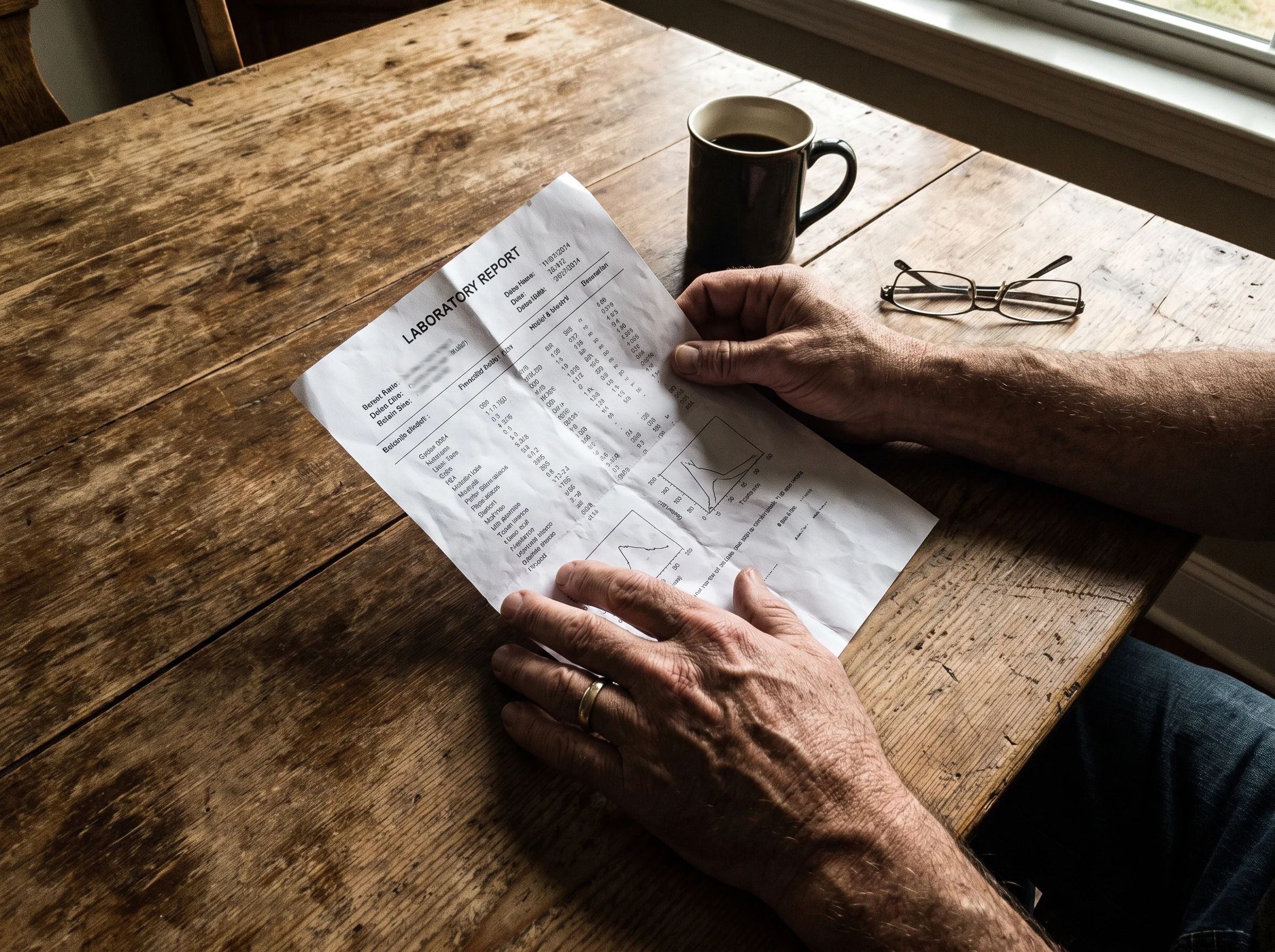
Then you go to your doctor. He runs your labs. He tells you everything looks "fine for your age."
Here is the trap. Normal for a 49-year-old American man is a low bar I refused to clear. Half the guys in that reference range feel exactly like you do. That does not make you healthy. That makes you average, in a country where average is exhausted.
Savage supports healthy testosterone production through ancestral nutrition, not through raising a number on a lab. I want to be clear about that. The goal is not chasing a number. The goal is feeling like yourself again.
Engine 3: Your cellular batteries are aging
This is the part almost nobody in the 3pm crash conversation talks about, and it is where the real fatigue lives.
Inside every cell in your body are tiny engines called mitochondria. They produce the actual energy you run on, a molecule called ATP. Every heartbeat, every thought, every rep in the gym, every erection, every cell repair. All of it is powered by mitochondria.
Mitochondria run on a compound called CoQ10. Research shows [4] that CoQ10 sits right in the middle of the energy-production machinery and helps make ATP. It also acts as an antioxidant. And here is the kicker: CoQ10 levels drop in some tissues as we age. Your heart, which never gets to rest, holds among the highest concentrations of CoQ10 in your body for a reason.
Think of CoQ10 like the charger for the batteries in every cell. Your heart is packed with it because it works the hardest. When the charger wears out, everything runs at half power.
That is not "getting old." That is a supply problem.
Now stack the three. Bad sleep drops your hormones. Lower hormones mean worse recovery. Worse recovery means less muscle, which means less mitochondria. Less mitochondria means less energy to lift, cook real food, or go to bed on time. So you patch it with caffeine, which wrecks sleep, which drops hormones further.
That is the loop. And you have been in it, quietly, for over a year.
Why Coffee Stopped Working
Coffee does not create energy. It blocks the "you are tired" signal in your brain. Big difference.
At 25, coffee unmasked energy you already had. It moved the reservoir into the pipes. At 48, there is less in the reservoir to unmask, and the caffeine is just noise on top of an empty tank.
I lived this. At 46, I was running four cups a day and still crashing at 3pm. So I added a fifth. Nothing. Then I started doing an afternoon espresso to muscle through the wall. And you know what happened?
I was wired at 11pm. Staring at the ceiling. Then a broken 5 hours of sleep. Then crashing at 3pm again. Then more coffee. Rinse, repeat, for about eight months.
The tool stopped working because I was using it to solve a problem it was never designed to fix. Coffee is a whip. It is not fuel. You can whip a tired horse only so many times before the horse quits on you in the middle of the road.
If you need an afternoon coffee to survive your day, you do not have a coffee problem. You have a sleep and cellular energy problem, and the coffee is making it worse.

"It's Just Aging" Is a Cop-Out (But So Is "Reverse Your Age")
I want to hold an honest middle here because both extremes are lying to you.
Yes, testosterone declines with age. Yes, mitochondrial function slows. Those are real biological facts. Any man selling you a bottle that promises to make you 25 again is selling you nothing.
But how fast, and how far, and how hard those declines hit you is not fixed. A 55-year-old who lifts three times a week, sleeps 7 hours, and eats real food does not hit the 3pm wall the way a 55-year-old on 5 hours of sleep and a Chipotle bowl does. Same age. Two different men.
You have been told this is just aging. You have been told your labs are fine. Both of those things can be technically true, and you can still feel like hell every afternoon. Those two facts do not obligate you to accept it.
Aging is real. Rolling over is a choice.
What Actually Moves the Needle (In Order)
I am giving you an order of operations, not a list of 15 tips. If you do these in this sequence, you will feel the difference. If you skip step one, nothing else will really work.
1. Sleep. Non-negotiable. Get to 7 hours before you optimize anything else.
Everything is downstream of sleep. Your hormones, your recovery, your appetite, your patience with your kids, your afternoon energy. If you are on 5 to 6 hours, this is the only thing that matters this week.
Cold room. Black out the windows. No screens after 10pm (I know, I know, do it anyway). Cut caffeine at noon, hard stop. Get outside for 10 minutes of morning sun to anchor your circadian clock. That is it. Do not optimize sleep. Just get more of it.
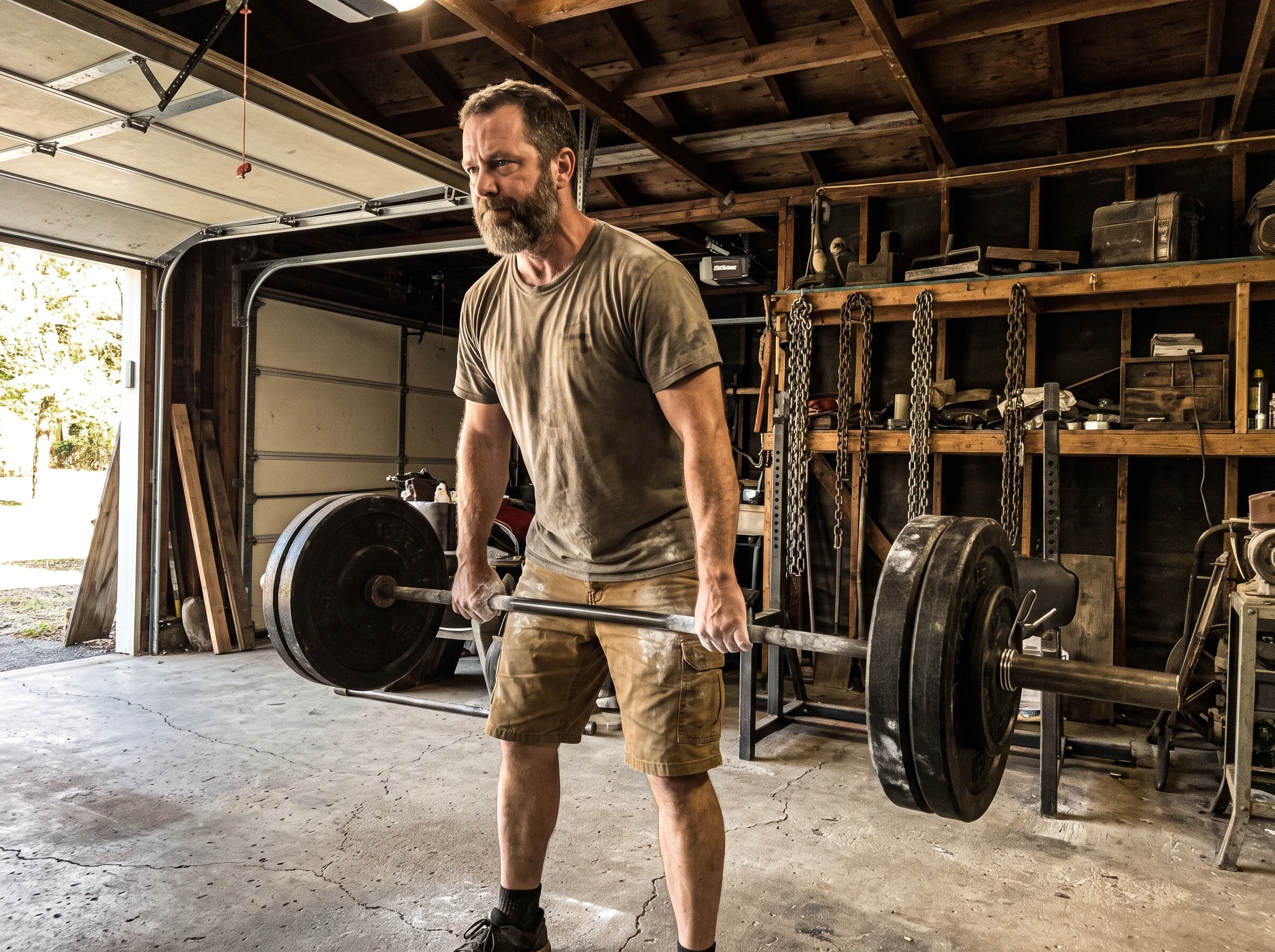
2. Lift heavy. Two or three times a week.
Testosterone is a major driver of muscle growth and strength, and heavy resistance exercise acutely raises testosterone [5] right after the session. More importantly, lifting builds muscle, and muscle is where mitochondria live. More muscle means more engines burning your afternoon fuel.
You do not need CrossFit. You do not need a program with a Latin name. Squat. Press. Pull. Walk. Do those consistently for six months and you will not recognize yourself in the mirror.
3. Feed the machine what it recognizes.
Start with protein at breakfast, not a bagel. Eggs, steak, ground beef. Whatever gets 40 grams of protein into you before 9am. This alone will steady your afternoons.
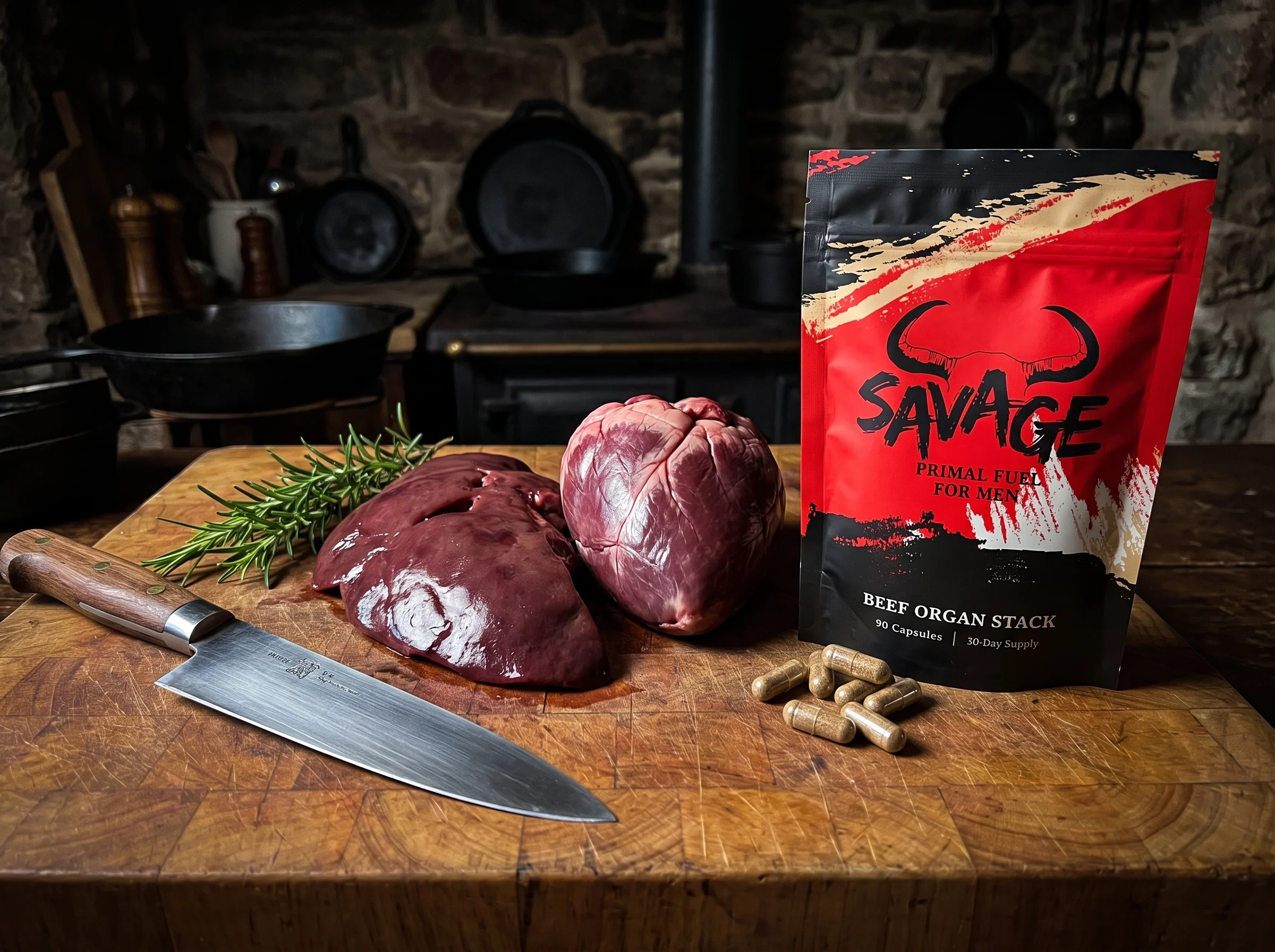
Then think about what your body is actually asking for. Our great-grandfathers ate the whole animal because the organs are where the nutrients concentrate. Liver is the richest source of preformed vitamin A on the planet, and vitamin A supports reproduction, immune function, and cellular communication [6]. Liver is also loaded with B12, which is required for red blood cell formation and energy metabolism [7] (fair warning from the NIH: B12 only helps energy if you are actually deficient, so no, popping a B12 gummy is not a cheat code if your levels are fine). Heart is packed with CoQ10. Kidney is a strong source of selenium, which supports antioxidant defense and thyroid function [8]. Organ tissue also concentrates zinc, which is essential for male reproductive development and function [9].
Here is the honest problem. Liver is nature's multivitamin, and it tastes like it lost a fight. There is not enough ketchup in the world to make me eat it every day, and I have tried. Kidney is worse. Testicle is a story for another article.
That gap, great for you but genuinely hard to stomach, is why I take the Savage Beef Organ Stack. Three capsules with breakfast. Six grass-fed organs (liver, heart, kidney, testicle, prostate, pituitary), freeze-dried raw. No gag reflex. It is not a stimulant. It will not paper over 5 hours of sleep or a Doritos diet. It is the raw material my engine had been missing for a decade because I stopped eating the way my grandfather ate.
It is the food, in a form I will actually take every single day.
4. Stop patching with caffeine.
Once you have sleep, lifting, and real food dialed, you will notice the coffee habit takes care of itself. I went from five cups to two. Not because I forced it. Because I stopped needing the whip.
What This Looks Like at 3pm, Six Months In
Here is the vision. And I mean it, because it is where I am now at 51, not where I was at 47.
You get to 3pm and you do not think about it. There is no wall. There is no moment where you contemplate closing your office door and lying down. You get up, refill your water, go back to work.
You get home and you have a second wind for your kid's practice instead of collapsing on the couch. You are the guy your wife sees at dinner, actually present, not glassy-eyed and half-asleep with his phone in his hand. You are the sharper guy in the room again at the 4pm meeting.
Not because you found a hack. Not because you took the right nootropic. Because you rebuilt the engine.
Common Mistakes I See Guys Make
Chasing the crash with more caffeine. You are patching a leaking roof with duct tape and the rain is only getting harder. Every espresso after 12pm robs from tomorrow morning.
Going straight to TRT before fixing sleep. I am not anti-TRT. I am anti-outsourcing your vitality to a prescription you cannot get off. Fix sleep, lifting, and food for six months first. See where you actually land. Then talk to a doctor if you still need to.
Buying a T-booster shelf. Ten bottles of stuff with names like "Alpha Fury XT." That is not a strategy, that is a hobby. Pick one or two things that address root cause and stack them on top of the basics.
Skipping breakfast. Intermittent fasting is fine for some guys. But if you are already crashing at 3pm, running on 5 hours of sleep, and skipping breakfast, you are lighting the last of your fuel on fire. Eat the eggs.
Waiting for motivation. Motivation is a lagging indicator. Energy comes back after you start doing the work, not before. Do not wait to feel like it.
FAQ: Why Your Energy Crashes at 3PM After 40
Why does the crash only happen at 3pm and not other times?
Because that is when your circadian dip lines up with the accumulated deficit of your morning. You have a natural biological sleepiness bump in the mid-afternoon regardless of what you ate. When you were 25, your reserves were deep enough to ride through it. Now they are not.
Is this low testosterone or just aging?
It is almost certainly both, plus poor sleep, plus tired mitochondria, plus a diet your body does not fully recognize. They all feed each other. That is why chasing "low T" as a single problem usually fails. Address the whole picture.
My labs are normal. Why do I feel like this?
Because "normal for your age" is a statistical range, not a definition of health. The bottom half of the range is exhausted. You can be technically inside the box and functionally in the basement. Trust how you feel, not the shrug of a rushed doctor.
Is a nap actually good, or am I making it worse?
A 20-minute nap before 3pm is fine and often useful. Longer than 30 minutes, or after 3pm, and you will wreck your sleep drive for that night. If you are napping every day, it is a signal you need more nighttime sleep, not more naps.
Why do I crash at 3pm but feel wired at 11pm?
Cortisol dysregulation and caffeine timing. Your body's stress hormone rhythm has flipped. You are running on caffeine and adrenaline through the day, and by the time you should be winding down, your nervous system is finally in gear. This is a sleep and stimulant problem. Cut caffeine at noon and see what happens in ten days.
Your One Next Step This Week
Get to 7 hours of sleep. Not 7 optimized, biohacked, deep-sleep-tracked hours. Just 7 hours in bed with the lights off and the phone in another room. Five nights in a row.
That is it. That is the whole assignment.
Everything else, the lifting, the protein, the organ nutrients, the coffee wean, builds on top of sleep. If you skip this step, none of the rest of it works.
The 3pm wall is a symptom. Chase the symptom, you get more coffee and a permanent afternoon fog. Chase the root, you get your afternoons back.
I got mine back at 48. Yours are still there. Go get them.
References
-
Monk TH. The Post-Lunch Dip in Performance. Clin Sports Med. 2005;24(2):e15-e23. View source
-
Leproult R, Van Cauter E. Effect of 1 Week of Sleep Restriction on Testosterone Levels in Young Healthy Men. JAMA. 2011;305(21):2173-2174. View source
-
Harman SM, et al. Longitudinal Effects of Aging on Serum Total and Free Testosterone Levels in Healthy Men. Baltimore Longitudinal Study of Aging. J Clin Endocrinol Metab. 2001;86(2):724-731. View source
-
Diaz-Casado ME, et al. The Paradox of Coenzyme Q10 in Aging. Nutrients. 2019;11(9):2221. View source
-
Vingren JL, et al. Testosterone Physiology in Resistance Exercise and Training. Sports Med. 2010;40(12):1037-1053. View source
-
NIH Office of Dietary Supplements. Vitamin A and Carotenoids: Fact Sheet for Health Professionals. View source
-
NIH Office of Dietary Supplements. Vitamin B12: Fact Sheet for Health Professionals. View source
-
NIH Office of Dietary Supplements. Selenium: Fact Sheet for Health Professionals. View source
-
NIH Office of Dietary Supplements. Zinc: Fact Sheet for Health Professionals. View source