Recovery and Performance After 40: The Real Fix
Recovery and performance after 40 isn't a training problem. It's a sleep, protein, and raw-material problem. Here's the honest fix from a 51-year-old coach.


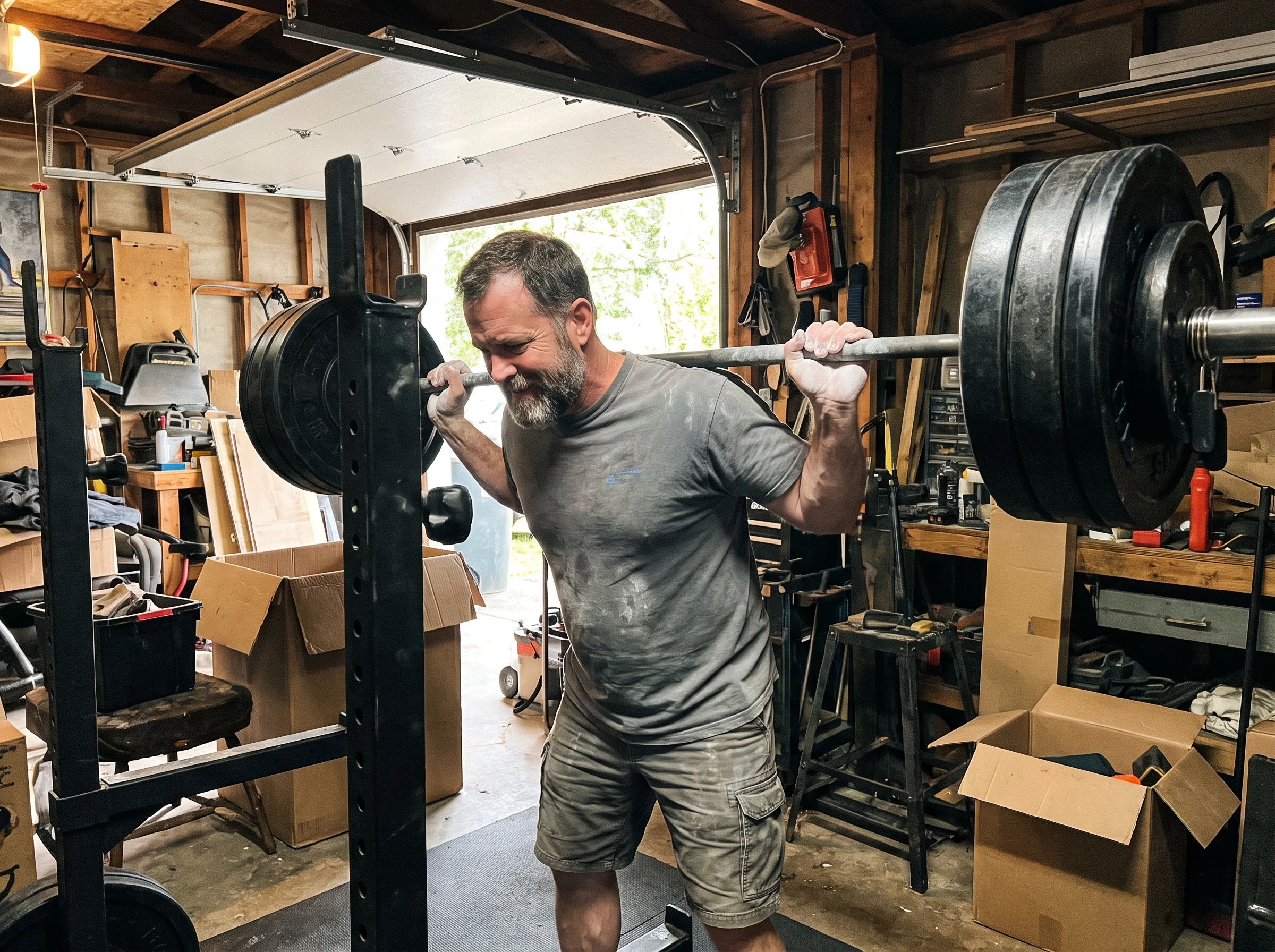
You did the same squat workout you've done a hundred times. Nothing crazy. Five sets, weight you've moved before, walked out of the garage feeling fine.
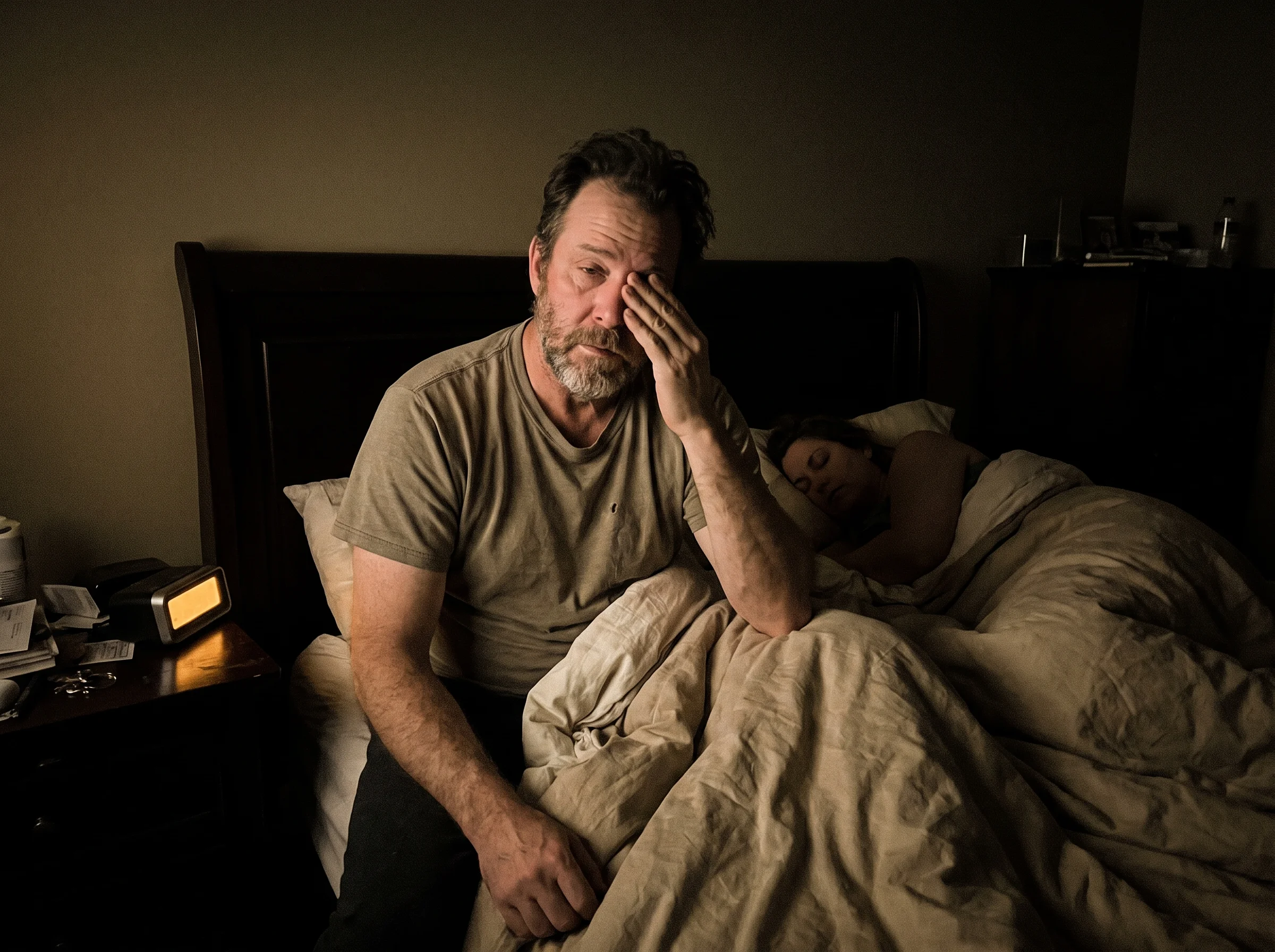
Four days later, your hips still ache going down the stairs. You slept like garbage two nights running. At 3pm on Wednesday you're staring at your monitor, reading the same email for the fourth time.
The workout didn't get harder. Something else changed. And nobody, not your doctor, not the guy at the gym, not the podcast you half-listened to on the drive in, has told you what.
Here is the honest version, from a guy who took a decade to figure it out: recovery and performance after 40 is not a training problem. You have a recovery problem wearing a training problem's uniform.
The Recovery Debt You've Been Quietly Paying
I'm 51. I spent most of my 40s watching the tank drain a quarter-inch a month. I didn't fall off a cliff. I leaked. And I made the same mistake almost every 40-plus guy I coach has made: I assumed the workout was the game.
Here's the reframe that changed everything for me. After 40, the workout isn't the game. The workout is the stress. Recovery is where the adaptation happens, or doesn't. The 22 hours off the gym floor decide whether that hour on it made you stronger or just beat you up.
At 25 that distinction didn't matter. Your recovery infrastructure was so overbuilt you could sleep five hours, eat pizza, drink beer, train legs, and be fine by Wednesday. At 45? That same math runs you into a wall.
You feel that too, right?

The 3pm crash you're blaming on yourself isn't a willpower issue. The post-lunch dip is a real, documented circadian event that happens even when you skip lunch [9]. Your body is on a clock. That clock doesn't care about your inbox.
Testosterone also falls gradually with age in healthy men [2]. That's real. But T is downstream of the same problem you need to fix first. Chase it as the headline and you'll spend three years and a lot of money missing the point.
The aha: the training isn't the problem. The 22 hours around it is.
Think of your body at 45 like a truck with a smaller gas tank than it had at 25. Same engine, same driver, smaller tank. If you keep driving the same distance without stopping to fill up, you don't need a new engine. You need to stop pretending the tank didn't change.
What Actually Slowed Down (It's Not Willpower)
Here's the kitchen-table version of what changed under the hood, and why you can't just "push through" your way out.
Every cell in your body has little power plants called mitochondria. They turn food and oxygen into ATP, the actual energy currency your muscles and brain run on. In a study of adults from 18 to 89, skeletal-muscle mitochondrial ATP production fell about 8 percent per decade [22].
Read that again. The machinery that makes your energy literally has less output every decade. That is not a mindset problem. That is a supply problem.
Riding shotgun in those power plants is a compound called CoQ10. Think of CoQ10 like the spark plug in the engine, it helps convert fuel into usable energy. CoQ10 sits in the mitochondrial inner membrane and links metabolism to ATP production, and levels decline in some tissues with age [3]. The heart holds among the highest CoQ10 concentrations in the body. There's a reason for that. The heart never gets a day off.
Now stack sleep on top. Sleep-deprived adults show higher baseline cortisol and a bigger response when you stress them [25]. Cortisol is fine in bursts. Elevated cortisol for years while you're also lifting, working, parenting, and eating like hell is a chemistry problem, not a mindset problem.
So you're 47, you're sleeping six hours if you're lucky, your mitochondria are running at maybe 80 percent of their 25-year-old output, your cortisol is up, and you're training the same way you did in your 30s.
That's not aging. That's a supply problem stacked on a sleep problem stacked on a training-load problem. Your doc calling your labs "normal" doesn't change any of it. Normal for a 49-year-old American man is a low bar I refused to clear.
The Three Levers For Recovery and Performance After 40
There are ten things you could work on. Three of them matter. The other seven are decoration.
Lever 1: Sleep (the one nobody wants to hear)
I know. Every article says sleep. It says it because it's true and because guys keep trying to buy their way around it.
Here's the number that stopped me cold. In healthy young men, restricting sleep to about 5 hours a night for one week lowered daytime testosterone by 10 to 15 percent [1]. That's in young men, in one week.
You are not a young man. You have been running on five to six hours for a decade. Do the math on that yourself.
Sleep is not a lever you can supplement past. It is the floor everything else is built on. You can spend $400 on a recovery ring, ice bath the front lawn, chug electrolytes at noon, and none of it beats an extra 90 minutes with your eyes shut.
If you fix nothing else this year, fix sleep. Seven hours minimum. Non-negotiable.
Lever 2: Protein and Training (the boring one that works)
Most protein guides quote numbers written for 22-year-old bodybuilders. The gerontology literature says the opposite: older adults need more protein per kilogram, not less.
Expert consensus for healthy older adults lands around 1.0 to 1.2 g/kg/day, and at least 1.2 if you're active [24]. A 200-pound guy is looking at 110 to 130 grams a day, minimum, spread across meals. Not one big shake at 4pm.
And you have to lift. Protein plus resistance training modestly builds muscle and strength, with returns plateauing around 1.6 g/kg/day [23]. Testosterone is also acutely elevated after heavy resistance training in men [8]. Meaning: your body treats lifting as a signal to run its own machinery harder.
More zone 2, more cardio, more walking, all good for the heart. Not the lever that saves your body composition at 50. Lifting is.
Two heavy sessions a week is the floor. Not three hours a day. Just heavy, real, and consistent.
Lever 3: Raw Material (the one guys skip)
Here's where every 40-plus program falls apart. You can sleep eight hours, hit your protein, and lift like a monk, but if the plate is calorie-dense and micronutrient-thin, you're building a house with two-by-fours made of cardboard.
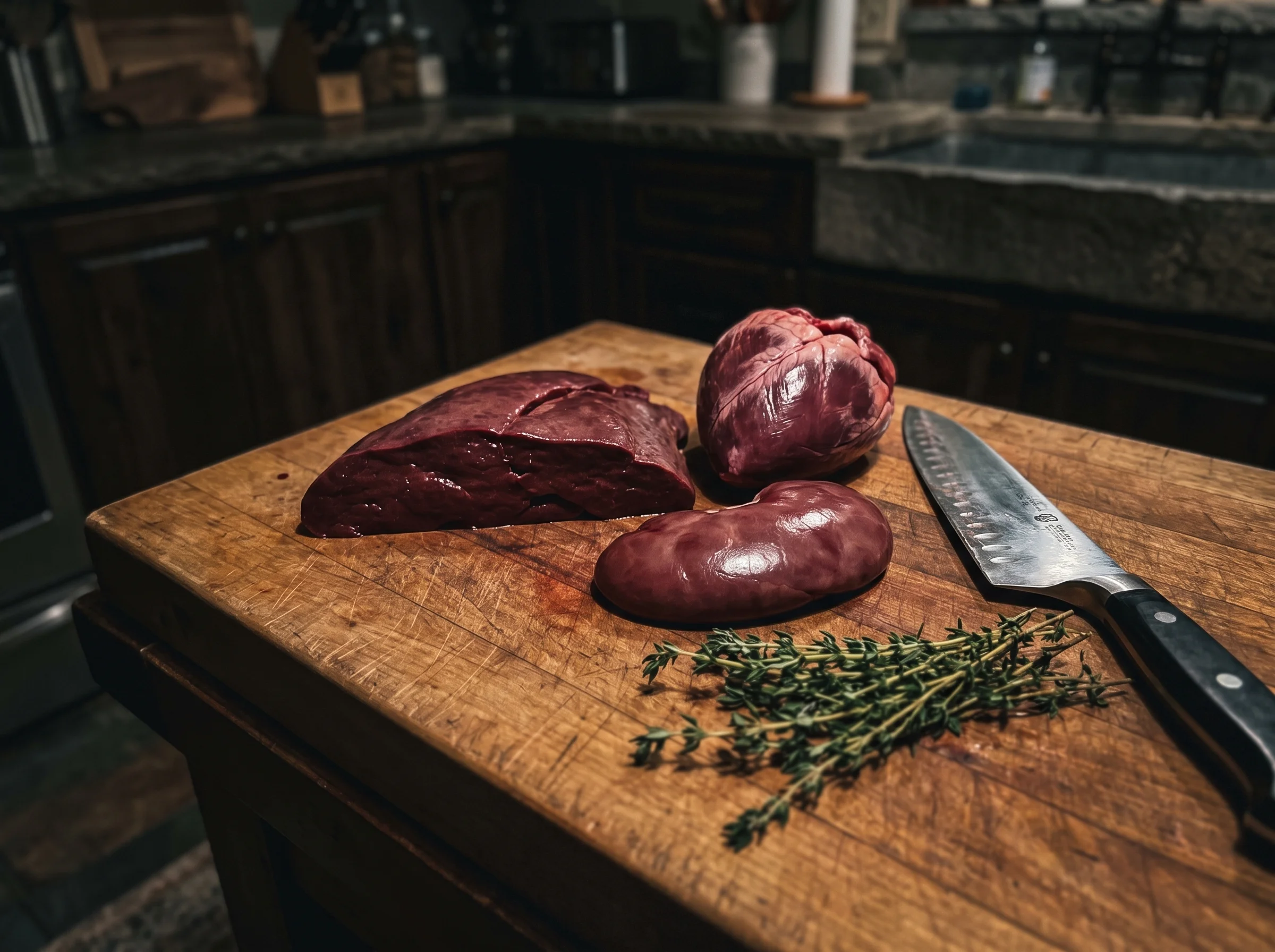
Modern American food is engineered for shelf life and taste, not for the trace nutrients your cells actually need to run. Meanwhile beef organs are documented as exceptionally nutrient-dense whole foods with complementary profiles [10][11]. Liver, heart, and kidney each carry a distinct concentrated micronutrient load your muscle-meat plate doesn't.
The specifics matter, so hang with me.
Liver is nature's multivitamin. It concentrates preformed vitamin A (retinol), which is the form your body uses directly [5]. When you eat plant carotenoids, you have to convert them to retinol, and that conversion is inefficient and varies wildly between people [18]. Some guys are getting a fraction of what the label suggests. Liver skips the coin flip.
Liver also carries choline, an essential nutrient men are especially prone to underconsuming [12][16]. And B12, which is required for energy metabolism and neurological function [6]. Fair warning: B12 doesn't do anything special if you're already replete. But if you're not, fatigue is one of the first symptoms.
Heart is where CoQ10 lives naturally in food. Raw beef heart holds more CoQ10 than liver or muscle, and here's the kicker: frying cuts recoverable CoQ10 to roughly 69 percent [13]. Cooking degrades the very compound you're trying to get.
Kidney brings selenium, which is built into the enzymes that handle antioxidant defense and thyroid hormone metabolism [7]. The thyroid holds more selenium than any other organ in your body. That's not a coincidence.
And zinc, which is essential for male reproductive function. Zinc deficiency causes hypogonadism [4]. That doesn't mean piling on zinc raises testosterone in a guy who has enough. It means running low is a real problem with a real name.
Now look at your last three days of food. Ask yourself honestly whether any of that showed up on your plate.
The Trap of Symptom-Chasing
Before you got here, you probably tried some of this:
More cardio. Made you more tired and didn't touch your body composition.
A generic T-booster off Amazon. Made your pee neon and did nothing else.
A cold plunge in the driveway. Felt hardcore for a week, changed nothing after a month.
Blamed the mattress, bought a new one, still slept like garbage.
None of these were dumb. They just treated symptoms one at a time on top of a raw-material and sleep deficit. You cannot ice-bath your way out of five hours of sleep. You cannot supplement your way out of a plate that's missing half the micronutrients your cells need.
TRT is the other tempting shortcut. And listen, I'm not anti-medicine. If you actually need it, you need it. But this reader, the one I'm writing for, isn't broken yet. He's leaking. And handing your endocrine system to a syringe for the rest of your life to fix a problem that might be sleep, protein, training load, and micronutrient supply is a big trade.
Fix the inputs first. If after 90 days of doing this right you still feel like hell, then have that conversation with a real doc. Ownership before outsourcing.
The shift: stop chasing the symptom, feed the system.
The Honest Middle
Here's where organ meat comes in, and here's the honest part nobody in this space says out loud.
Organ meat is some of the most nutrient-dense food on earth. It is also, for most of us, genuinely unpleasant to eat every day.
I tried. I bought grass-fed liver from the farmer's market, watched three YouTube videos on soaking it in milk, seared it in cast iron with onions and bacon fat. Ate half. Threw the other half in the trash. My kids looked at me like I'd lost a bet.
Liver is nature's multivitamin. It also tastes like it lost a fight. There is not enough ketchup in the world to make me eat it every day, and I coach this stuff for a living.
That gap, great for you but hard to stomach, is the entire reason the Savage Beef Organ Stack exists. Six freeze-dried, grass-fed and pasture-raised bovine organs in a capsule: liver, heart, kidney, testicle, prostate, and pituitary. Three capsules a day with food. No cooking, no gag reflex.
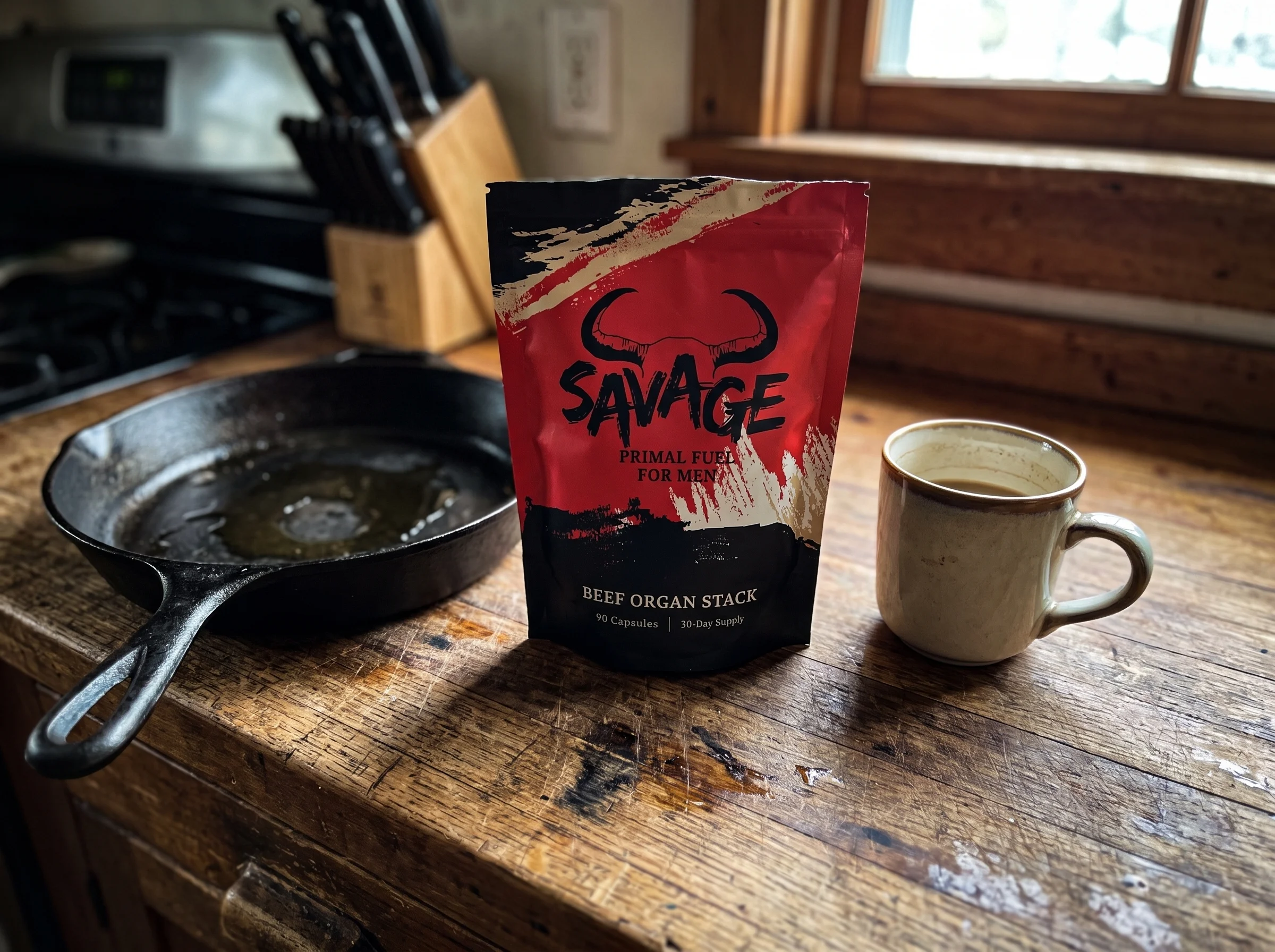
Freeze-drying matters here. It removes water at low temperature under vacuum and preserves heat-sensitive quality better than hot-air drying [19]. Cooked liver, for reference, loses about 41 percent of its folate broiled and about 50 percent fried [20]. Freeze-drying isn't magic and it's not a sterilization step. It just isn't cooked to death.
I take the Stack every morning. It doesn't replace my sleep, my protein, or my lifting. It sits on top of them, feeding the raw-material layer those three levers can't fix on their own. Structure and function language only: it supports healthy testosterone production, energy, recovery, and hormonal balance. That's the ceiling of what I'll say, because that's the ceiling of what I know.
If you can put beef liver on the plate three times a week, God bless. Do that. If you know yourself, and you know you won't, that's what the Stack is for.
What The Next 30 Days Look Like
One clean order of operations. Do them in this order. Don't skip to step four.
1. Sleep gets the first fix. Seven hours minimum, non-negotiable. Phone out of the bedroom. Room cold and dark. If you can't sleep seven, don't add anything else until you figure out why. No hack replaces this.
2. Hit your protein. Aim for 1.2 grams per kilogram of bodyweight, spread across three or four meals. Real food. Eggs, beef, fish, chicken, dairy. If you weigh 200 pounds, that's 110 grams. Track it for a week so you know what it actually looks like, then stop tracking and eat that way.
3. Lift heavy, twice a week minimum. Squat, hinge, push, pull. Real weight. Not more cardio.
4. Fix the raw material layer. Organs on the plate if you can stomach it. If you can't, the Savage Beef Organ Stack is the practical fix. Three capsules with food.
5. Give it 60 to 90 days before you judge it. Your body didn't downgrade in three weeks. It's not upgrading in three weeks either.
One note on iron. If you've ever been told you have high ferritin, hemochromatosis, or your doc has told you to limit iron intake, talk to a clinician before starting any organ product. Organs contain iron, and iron is one of those things where more is not better if your stores are already full.
Common Mistakes I See With Recovery and Performance After 40
Stacking supplements on top of a five-hour sleep habit. Fix the sleep. Then talk about supplements. Nothing else works if that's broken.
Training more when tired, instead of training smarter when rested. Volume is not the answer at 45. Intensity plus recovery is.
Eyeballing protein instead of counting for one week. Almost every guy I coach thinks he eats more protein than he does. Almost every guy is wrong by 30 to 50 grams a day.
Judging any change on a two-week timeline. You built this hole over ten years. Give the climb at least 60 days.
Waiting to feel motivated. Motivation is a byproduct of getting the inputs right, not a prerequisite. Do the work while you feel like hell. The feeling like hell part passes.
FAQ
Why does it take me four days to recover from a workout that used to take one?
Because your mitochondrial output is lower, your sleep is likely shorter and lighter, and your plate is probably missing the micronutrients your cells use to rebuild. The workout didn't get harder. The recovery budget got smaller. Same session, different bank account.
Should I train less at 45 or train differently?
Different, mostly. Same big lifts, less junk volume, more attention to sleep and food between sessions. Two hard sessions a week beats four mediocre ones on four hours of sleep.
Is it really testosterone, or is it something else?
It's probably everything at once, and testosterone is one output of a system that's under-slept, under-fed, and under-recovered. Fix the inputs for 90 days before you assume the answer is a prescription.
How much protein do I actually need at 50?
Around 1.0 to 1.2 grams per kilogram per day at minimum, higher if you're lifting seriously [24]. For most middle-aged men that's 100 to 150 grams a day. Real food, spread across meals.
Can nutrition alone fix this, or do I need TRT?
For most guys who aren't clinically hypogonadal, the inputs (sleep, protein, training, micronutrients) haven't been given a real 90-day run. Try that first. If you're still in the hole after honest effort, that's when the real doctor conversation makes sense.
The Honest Bottom Line
The 3pm crash, the four-day soreness, the short fuse with your kids on a Wednesday night when nothing happened, the guy in the mirror you don't quite recognize, that ends when the tank stops running dry. Not overnight. Not in a week. But it ends.
The science lines up. Sleep, protein, training, and raw material are the levers. Everything else on the internet is decoration.
This is different from another T-booster because it isn't chasing one number. It's different from jumping straight to TRT because it fixes what got missed, not what showed up on the lab. It's boring, it's slow, and it works.
Pick the lever you've been avoiding the longest. Start there Monday.
That's how you get your body back on your own terms.
References
[1] Leproult R, Van Cauter E. Effect of 1 Week of Sleep Restriction on Testosterone Levels in Young Healthy Men. JAMA. 2011;305(21):2173-2174. https://jamanetwork.com/journals/jama/fullarticle/1029127
[2] Harman SM, et al. Longitudinal Effects of Aging on Serum Total and Free Testosterone Levels in Healthy Men (Baltimore Longitudinal Study of Aging). J Clin Endocrinol Metab. 2001;86(2):724-731. https://academic.oup.com/jcem/article/86/2/724/2841070
[3] Diaz-Casado ME, et al. The Paradox of Coenzyme Q10 in Aging. Nutrients. 2019;11(9):2221. https://pmc.ncbi.nlm.nih.gov/articles/PMC6770889/
[4] NIH Office of Dietary Supplements, Zinc Fact Sheet for Health Professionals. https://ods.od.nih.gov/factsheets/Zinc-HealthProfessional/
[5] NIH Office of Dietary Supplements, Vitamin A and Carotenoids Fact Sheet for Health Professionals. https://ods.od.nih.gov/factsheets/VitaminA-HealthProfessional/
[6] NIH Office of Dietary Supplements, Vitamin B12 Fact Sheet for Health Professionals. https://ods.od.nih.gov/factsheets/VitaminB12-HealthProfessional/
[7] NIH Office of Dietary Supplements, Selenium Fact Sheet for Health Professionals. https://ods.od.nih.gov/factsheets/Selenium-HealthProfessional/
[8] Vingren JL, et al. Testosterone Physiology in Resistance Exercise and Training. Sports Med. 2010;40(12):1037-1053. https://link.springer.com/article/10.2165/11536910-000000000-00000
[9] Monk TH. The Post-Lunch Dip in Performance. Clin Sports Med. 2005;24(2):e15-e23. https://pubmed.ncbi.nlm.nih.gov/15892914/
[10] Fuerniss HF, et al. Nutrient Analysis of Raw United States Beef Offal Items. Nutrients. 2024;16(18):3104. https://pubmed.ncbi.nlm.nih.gov/39339704/
[11] USDA FoodData Central SR Legacy, beef liver 169451 / heart 168625 / kidney 169449. https://fdc.nal.usda.gov/food-details/169451/nutrients
[12] USDA Database for the Choline Content of Common Foods, Release 2 (2008). https://www.ars.usda.gov/ARSUserFiles/80400525/data/choline/choln02.pdf
[13] Ercan P, El SN. Changes in Content of Coenzyme Q10 in Beef Muscle, Beef Liver and Beef Heart with Cooking and In Vitro Digestion. J Food Compost Anal. 2011;24(8):1136-1140. https://www.sciencedirect.com/science/article/pii/S0889157511001517
[16] Fischer LM, et al. Sex and Menopausal Status Influence Human Dietary Requirements for the Nutrient Choline. Am J Clin Nutr. 2007;85(5):1275-1285. https://pubmed.ncbi.nlm.nih.gov/17490963/
[18] Tang G. Bioconversion of Dietary Provitamin A Carotenoids to Vitamin A in Humans. Am J Clin Nutr. 2010;91(5):1468S-1473S. https://pubmed.ncbi.nlm.nih.gov/20200262/
[19] Ratti C. Hot Air and Freeze-Drying of High-Value Foods: A Review. J Food Eng. 2001;49(4):311-319. https://www.sciencedirect.com/science/article/pii/S0260877400002284
[20] Aramouni FM, Godber JS. Folate Retention in Beef Liver Cooked and Then Stored by Various Methods. J Food Qual. 1991;14(5):357-365. https://onlinelibrary.wiley.com/doi/10.1111/j.1745-4557.1991.tb00077.x
[22] Short KR, et al. Decline in Skeletal Muscle Mitochondrial Function with Aging in Humans. PNAS. 2005;102(15):5618-5623. https://pubmed.ncbi.nlm.nih.gov/15800038/
[23] Morton RW, et al. A Systematic Review, Meta-Analysis and Meta-Regression of the Effect of Protein Supplementation on Resistance Training-Induced Gains in Muscle Mass and Strength in Healthy Adults. Br J Sports Med. 2018;52(6):376-384. https://pubmed.ncbi.nlm.nih.gov/28698222/
[24] Bauer J, et al. Evidence-Based Recommendations for Optimal Dietary Protein Intake in Older People: A Position Paper from the PROT-AGE Study Group. J Am Med Dir Assoc. 2013;14(8):542-559. https://pubmed.ncbi.nlm.nih.gov/23867520/
[25] Minkel J, et al. Sleep Deprivation Potentiates HPA Axis Stress Reactivity in Healthy Adults. Health Psychol. 2014;33(11):1430-1434. https://pubmed.ncbi.nlm.nih.gov/24818608/