Beef Liver vs Multivitamin: Why Your Grandpa Had More Gas
Beef liver vs multivitamin: why the ugliest food on the shelf beats the orange pill you swallow every morning, and what to do when you won't cook it.


Picture your grandfather at 52. He was not counting macros or splitting a horse pill in half over the sink at 6am. He also was not falling asleep in his recliner at 8:30pm on a Tuesday, wondering where the guy in his wedding photos went.
You take a multivitamin. He ate liver on Sunday. Somehow he had more gas in the tank than you do.
That is worth sitting with for a second. The whole beef liver vs multivitamin question starts right there, at your grandfather's Sunday plate.
The Rainbow Pill and the 3pm Wall
Here is the scene I lived for about three years in my mid-40s.
Wake up. Coffee. Swallow a name-brand multivitamin the size of a small pistachio. Feel virtuous. Drive to work. Crush emails until about 2:45pm, then hit a wall so hard I would reread the same sentence four times and still not know what it said. Coffee number three. Home. Dinner. Recliner. Out cold before the kid finished the movie.
The pill was orange, and I paid for it, and it did nothing I could feel.
You feel that too? The 3pm wall is real, by the way. It is a documented mid-afternoon dip in alertness that shows up even on the days you skip lunch, because it is partly wired into your circadian clock, not just a food coma [9]. So no, you are not soft. You are not weak. Something in the machine is running low.
The question I could not answer at 45 was the obvious one. If the pill was doing its job, why did I feel like this?
I found the answer in the ugliest food on the shelf.

A Multivitamin Is a Photograph of the Meal
Let me tell you what a multivitamin actually is, in plain English.
It is a bag of isolated synthetic compounds, mixed and pressed to hit the numbers on a nutrition label. Some of those compounds are close to what your body expects. Some are chemical cousins your body has to translate before it can use them. All of it is engineered backwards, starting from an RDA chart and working toward a tablet.
Here is the analogy I use with the guys I coach.
A multivitamin is a photograph of a steak dinner. It has all the right colors in the right places. Looks like the thing. Will not feed you.
Take vitamin A. The version in most multivitamins is beta-carotene, a plant precursor your body has to convert into retinol, the form your cells actually use. That conversion is inefficient and varies wildly from person to person. The estimates run anywhere from about 4 to 1 up to 28 to 1 by weight [18]. So the same "100 percent daily value" on the label can mean very different things in two different bodies. You have no idea which body you have.
Or B12. If you are already replete, per the NIH, extra B12 does not improve energy or performance [6]. So that big red B12 number on your gummy pack is doing exactly nothing you can feel, assuming your diet is already covering it. If you are deficient, the pill helps. If you are not, it is decoration.
That is not a scam. It is just the wrong tool for what most middle-aged men think they are buying.
You are not buying insurance against a paperwork deficiency. You are buying, in your head, a return of the energy and clarity you had ten years ago. A photograph does not deliver that.
Liver Is the Meal Your Grandfather Ate Without Thinking
Now flip the frame.
Beef liver is not a chemistry set trying to reverse-engineer nutrition. It is nutrition. It is a co-evolved package of the exact forms your cells were built to read, sitting inside the same organ you would have eaten if you had been born a hundred years earlier.
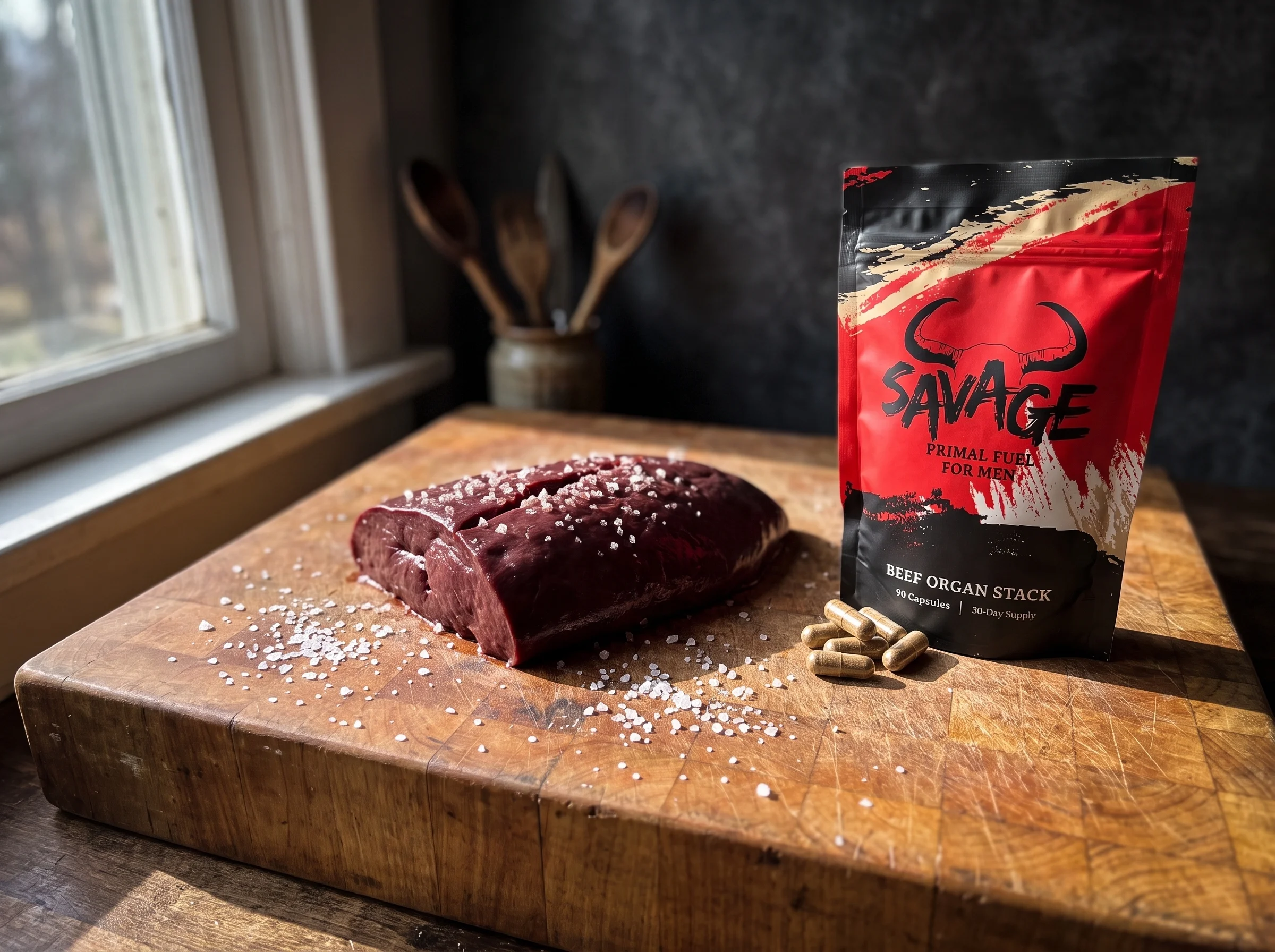
Look at what is actually in it, according to USDA's own food database and a 2024 nutrient analysis of raw United States beef offal: preformed vitamin A (retinol, no conversion required), B12, folate, copper, riboflavin, iron, and choline, all in the forms and ratios your body evolved around [10][11].
Preformed retinol is the big one. Your body does not roll dice on the conversion. It gets the finished vitamin, the same way your grandfather got it every time he cleaned his plate on Sunday [5][18].
Then there is choline, which almost nobody talks about. Raw beef liver runs around 330 mg of total choline per 100 grams [12]. Choline is essential for cell membranes, fat transport, and the neurotransmitter your brain uses to think clearly. When researchers put men on severe choline restriction, 77 percent developed reversible signs of liver or muscle dysfunction [16]. Men are the group most likely to be running low.
Higher choline intake has also been linked, in observational data from the Framingham Offspring cohort, to better verbal and visual memory and fewer white-matter lesions in the brain [17]. That is an association, not a promise. But it tells you the machine cares about this nutrient, and modern grocery aisles are not exactly pushing it.
Iron in liver comes in an animal-food matrix that absorbs more consistently than plant iron when your stores are low, running about 14 to 18 percent bioavailability from mixed animal-containing diets versus 5 to 12 percent from vegetarian ones [14]. And when iron status is inadequate, correcting it reduces self-reported fatigue [15]. That is the deficiency-only story. If your ferritin is already fine, more is not better.
Which brings me to the honest safety note nobody in this niche wants to give you. If you have hemochromatosis, high ferritin, or your doctor has told you to limit iron, you should talk to a clinician before piling on iron and vitamin A from any organ source. Liver is dense. That is the point, and that is the caution.
But Liver Tastes Like It Lost a Fight
Here is where I have to be honest with you, dad to dad.
The first time I tried to cook liver in my own kitchen, I gagged through half a serving standing at the counter. My wife walked in, wrinkled her nose, and asked what died. I stood there, 46 years old, chewing something my body clearly recognized as food and my brain absolutely did not.
That was the last time I cooked liver on a Tuesday.
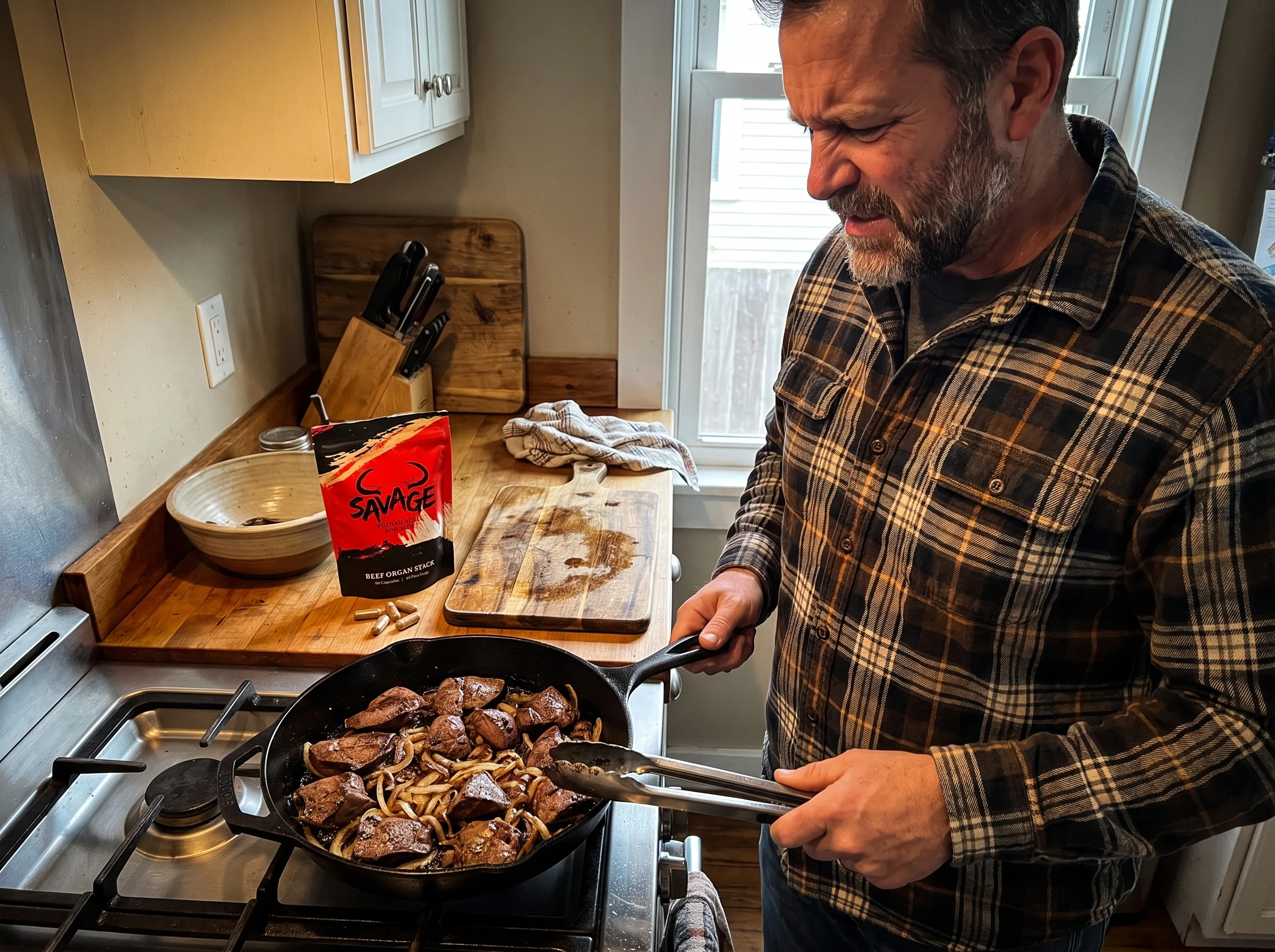
Liver is nutritionally elite and genuinely unpleasant to eat. There is not enough onion, bacon, or ketchup in the world to make it a Wednesday meal after a ten hour day. Anybody telling you to "just eat liver twice a week" has never tried to make that a household habit while a wife and two kids are eyeing you like you have finally lost it.
And here is the part almost no article on beef liver vs multivitamin mentions. Even when you do cook it, you are leaking nutrients before it hits the plate. Broiling beef liver drops folate by about 41 percent. Frying, about 50 [20]. CoQ10 in beef heart takes a similar hit under heat [13]. So the version of liver you would actually eat, seared hard because rare liver is a bridge too far, is a diminished version of the chart everybody else is quoting.
Great food. Terrible delivery.
This is the exact gap that made me pay attention to freeze-dried organ products in the first place. Lyophilization, the fancy word for freeze-drying, removes water at low temperature under vacuum and preserves heat-sensitive structure better than hot-air drying [19]. It is not identical to fresh, and it is not a microbial kill step, and I would not trust anyone who tells you it locks in every nutrient. But it sidesteps the sustained cooking heat that cuts folate in half.
That is why I take the Savage Beef Organ Stack every morning, and why I put the men I coach on it. Three capsules. Six organs. No gagging at the counter. I did not found the company and I did not formulate the product. I found it, it worked, and it filled the gap between "food I know I should be eating" and "food I will actually eat on a Wednesday."
The best food in the world is still the food you will actually put in your mouth.
Liver Alone Is Not the Whole Answer Either
Now let me push back on my own tribe for a second.
A lot of carnivore takes online will tell you liver is the multivitamin. Just eat liver, bro. That is closer to the truth than the drugstore aisle, but it is not the full truth. Different organs carry different strengths, and stacking them is why the whole animal thing exists in the first place.
Heart is CoQ10 rich [13]. CoQ10 is a compound that sits in the mitochondrial membrane and helps run the cellular energy line, and it declines in some tissues with age [3]. Ordinary cooking degrades some of the CoQ10 in heart tissue, which is a decent argument for a raw, freeze-dried version.
Kidney brings selenium, built into selenoproteins that support antioxidant defense and thyroid hormone metabolism. The thyroid holds more selenium than any other tissue in the body [7].
Prostate has historically been a source of zinc. Zinc deficiency (deficiency only, not a hack for topped-off men) is tied to reproductive function [4].
The ancestral point: your grandfather did not eat only liver. He ate whatever the animal gave him. Different tissue, different nutrient signatures, complementary strengths.
Here is the aging beat, without any product promise attached. Skeletal-muscle ATP production, meaning the raw output of your cellular energy machinery, drops about 8 percent per decade in adults from 18 to 89 [22]. That is why food quality, sleep, and training matter more every year you are alive. You are not "just getting older." Your machine has fewer batteries running fewer cycles, and it deserves better fuel, not worse.
So, Beef Liver vs Multivitamin. What Actually Wins?
Here is the honest verdict on beef liver vs multivitamin.
A multivitamin is paperwork insurance. If your diet has holes, it patches some of them, in synthetic forms of variable usefulness. It is not nothing. It is not what you think it is either.
Liver, and organs more broadly, is dense whole food nutrition in the forms your body reads without a translator. Preformed retinol. Bioavailable B12. Choline. An iron matrix that absorbs consistently in people who need it. It wins on form, matrix, and evolutionary fit.
But a capsule you actually take beats a plate of liver you never cook.
If you love cooking organs, love your grocer, and your household is on board, eat the food. Nothing beats that. If you are like me and 90 percent of the men I coach, and the honest answer is "I will not cook liver on a Tuesday no matter how good it is for me," then you are choosing between a photograph and a delivery system for the real meal. That is not a hard call.
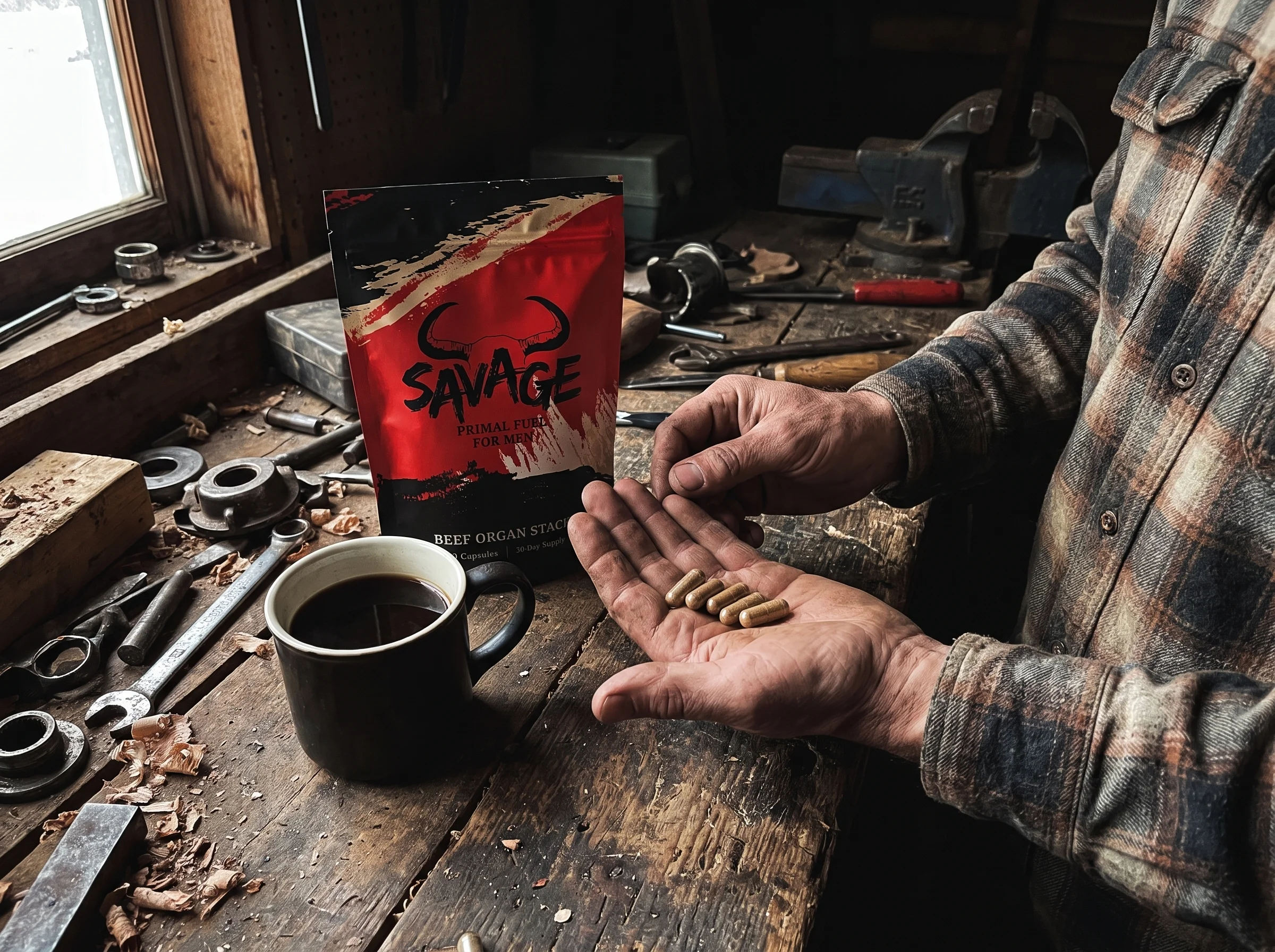
And do not miss the foundations while you are optimizing your supplement drawer. No capsule fixes 5 hours of sleep. When you are underslept, your cortisol response to stress climbs [25], and even young healthy men lost measurable testosterone after a week of short sleep [1]. Testosterone declines with age regardless [2]. So the play is not to chase a pill, it is to feed the machine, sleep the machine, and load the machine. Protein for older adults sits around 1.0 to 1.2 grams per kilo per day, more if you are training [24]. Heavy resistance training acutely raises testosterone right after the session [8]. That is the base. Organs sit on top of the base, not instead of it.
That is the whole picture.
Frequently Asked Questions
Is beef liver really better than a multivitamin, or is that just carnivore hype?
Better in what sense. Liver wins on form and matrix, the nutrients in it are in the shape your body reads immediately. A multivitamin wins on convenience and label completeness. If you had to pick one and you would actually eat the liver, liver. If you would not, the multivitamin at least does something, and a freeze-dried organ product bridges the gap.
If I take a multivitamin, do I still need organ meat?
You do not "need" it the way you need protein or sleep. But the forms of vitamin A, choline, B12, and iron you get from liver are hard to fully match with a synthetic pill, and choline in particular is a nutrient most American men run low on. So it is a real addition, not a redundancy.
How often would I have to eat liver to replace my multivitamin?
Once or twice a week of a real serving would meaningfully change your intake of vitamin A, B12, copper, and choline. Almost nobody does it. That gap is why organ capsules exist.
Can you get too much vitamin A from liver?
Yes, in principle. Liver is very concentrated in preformed retinol, and preformed retinol is the form you can actually overdo if you go wild with it. Portions matter. Freeze-dried organ blends are dosed with this in mind, but if you have any liver condition, are pregnant, or have been told to limit vitamin A, talk to your clinician.
What about iron, will liver overload me?
Only a risk if you already have iron overload issues like hemochromatosis or high ferritin. In men with normal iron status, food-source iron self-regulates far better than iron injections or high-dose iron pills. If you have any family history of iron disorders, get labs before adding any iron-containing organ product.
Are liver capsules the same as eating fresh liver?
Not identical. Freeze-drying preserves many heat-sensitive components better than cooking, but it is not fresh liver in a pill. It is a concentrated delivery of the dry mass. For most men who will never cook organs, it is the practical version of "eating liver."
Why do I feel different on liver but not on my multivitamin?
Two likely reasons. First, liver hands you finished forms of nutrients your body does not have to convert, which for some nutrients matters a lot. Second, liver carries choline, copper, and preformed retinol at levels a standard multivitamin often does not touch. That said, if you feel something dramatic on day three, temper expectations. Real food effects are slow and cumulative.
The One Thing to Do This Week
Pick up your current multivitamin. Read the label. Look for choline. Look at what form the vitamin A is in.
If choline is missing and the vitamin A is beta-carotene only, you now know something about that orange pill you did not know this morning.
From there you have two moves. Cook liver this weekend and see how the household handles it. Or, if that is not you, look at a freeze-dried organ stack that carries liver alongside heart, kidney, and the rest of the animal. I take the Savage Beef Organ Stack every morning with breakfast because it is the version of "eating like my grandfather" that I will actually do on a Tuesday. Three capsules. Six organs. No gag reflex.
You are not soft. You are not weak. You have been feeding a machine built for a plate it stopped seeing decades ago.
Give it the meal, not the photograph. And see how the man in the mirror answers back.
References
[1] Leproult R, Van Cauter E. Effect of 1 Week of Sleep Restriction on Testosterone Levels in Young Healthy Men. JAMA. 2011;305(21):2173-2174. https://jamanetwork.com/journals/jama/fullarticle/1029127
[2] Harman SM, et al. Longitudinal Effects of Aging on Serum Total and Free Testosterone Levels in Healthy Men (Baltimore Longitudinal Study of Aging). J Clin Endocrinol Metab. 2001;86(2):724-731. https://academic.oup.com/jcem/article/86/2/724/2841070
[3] Diaz-Casado ME, et al. The Paradox of Coenzyme Q10 in Aging. Nutrients. 2019;11(9):2221. https://pmc.ncbi.nlm.nih.gov/articles/PMC6770889/
[4] NIH Office of Dietary Supplements, Zinc Fact Sheet for Health Professionals. https://ods.od.nih.gov/factsheets/Zinc-HealthProfessional/
[5] NIH Office of Dietary Supplements, Vitamin A and Carotenoids Fact Sheet for Health Professionals. https://ods.od.nih.gov/factsheets/VitaminA-HealthProfessional/
[6] NIH Office of Dietary Supplements, Vitamin B12 Fact Sheet for Health Professionals. https://ods.od.nih.gov/factsheets/VitaminB12-HealthProfessional/
[7] NIH Office of Dietary Supplements, Selenium Fact Sheet for Health Professionals. https://ods.od.nih.gov/factsheets/Selenium-HealthProfessional/
[8] Vingren JL, et al. Testosterone Physiology in Resistance Exercise and Training. Sports Med. 2010;40(12):1037-1053. https://link.springer.com/article/10.2165/11536910-000000000-00000
[9] Monk TH. The Post-Lunch Dip in Performance. Clin Sports Med. 2005;24(2):e15-e23. https://pubmed.ncbi.nlm.nih.gov/15892914/
[10] Fuerniss HF, et al. Nutrient Analysis of Raw United States Beef Offal Items. Nutrients. 2024;16(18):3104. https://pubmed.ncbi.nlm.nih.gov/39339704/
[11] USDA FoodData Central SR Legacy, beef liver 169451 / heart 168625 / kidney 169449. https://fdc.nal.usda.gov/food-details/169451/nutrients
[12] USDA Database for the Choline Content of Common Foods, Release 2 (2008). https://www.ars.usda.gov/ARSUserFiles/80400525/data/choline/choln02.pdf
[13] Ercan P, El SN. Changes in content of coenzyme Q10 in beef muscle, beef liver and beef heart with cooking and in vitro digestion. J Food Compost Anal. 2011;24(8):1136-1140. https://www.sciencedirect.com/science/article/pii/S0889157511001517
[14] Hurrell R, Egli I. Iron bioavailability and dietary reference values. Am J Clin Nutr. 2010;91(5):1461S-1467S. https://pubmed.ncbi.nlm.nih.gov/20200263/
[15] Houston BL, et al. Efficacy of iron supplementation on fatigue and physical capacity in non-anaemic iron-deficient adults: a systematic review of randomised controlled trials. BMJ Open. 2018;8:e019240. https://pubmed.ncbi.nlm.nih.gov/29626044/
[16] Fischer LM, et al. Sex and menopausal status influence human dietary requirements for the nutrient choline. Am J Clin Nutr. 2007;85(5):1275-1285. https://pubmed.ncbi.nlm.nih.gov/17490963/
[17] Poly C, et al. The relation of dietary choline to cognitive performance and white-matter hyperintensity in the Framingham Offspring Cohort. Am J Clin Nutr. 2011;94(6):1584-1591. https://pubmed.ncbi.nlm.nih.gov/22071706/
[18] Tang G. Bioconversion of dietary provitamin A carotenoids to vitamin A in humans. Am J Clin Nutr. 2010;91(5):1468S-1473S. https://pubmed.ncbi.nlm.nih.gov/20200262/
[19] Ratti C. Hot air and freeze-drying of high-value foods: a review. J Food Eng. 2001;49(4):311-319. https://www.sciencedirect.com/science/article/pii/S0260877400002284
[20] Aramouni FM, Godber JS. Folate losses in beef liver due to cooking and frozen storage. J Food Qual. 1991;14(5):357-365. https://onlinelibrary.wiley.com/doi/10.1111/j.1745-4557.1991.tb00077.x
[22] Short KR, et al. Decline in skeletal muscle mitochondrial function with aging in humans. PNAS. 2005;102(15):5618-5623. https://pubmed.ncbi.nlm.nih.gov/15800038/
[24] Bauer J, et al. Evidence-based recommendations for optimal dietary protein intake in older people: a position paper from the PROT-AGE Study Group. J Am Med Dir Assoc. 2013;14(8):542-559. https://pubmed.ncbi.nlm.nih.gov/23867520/
[25] Minkel J, et al. Sleep deprivation and stressors: evidence for elevated negative affect in response to mild stressors when sleep deprived. Health Psychol. 2014;33(11):1430-1434. https://pubmed.ncbi.nlm.nih.gov/24818608/