Nutritional Deficiencies in Men: Why You're Tired at 3pm
Discover the most common nutritional deficiencies in men that doctors often miss. Learn how to identify and fix nutritional deficiencies in men naturally.


You hit the wall at 3pm. Not tired exactly. Done. You stare at the same email for ten minutes, refill the coffee for the third time, and start counting the hours until you can lie down on the couch and pretend you're watching the game.
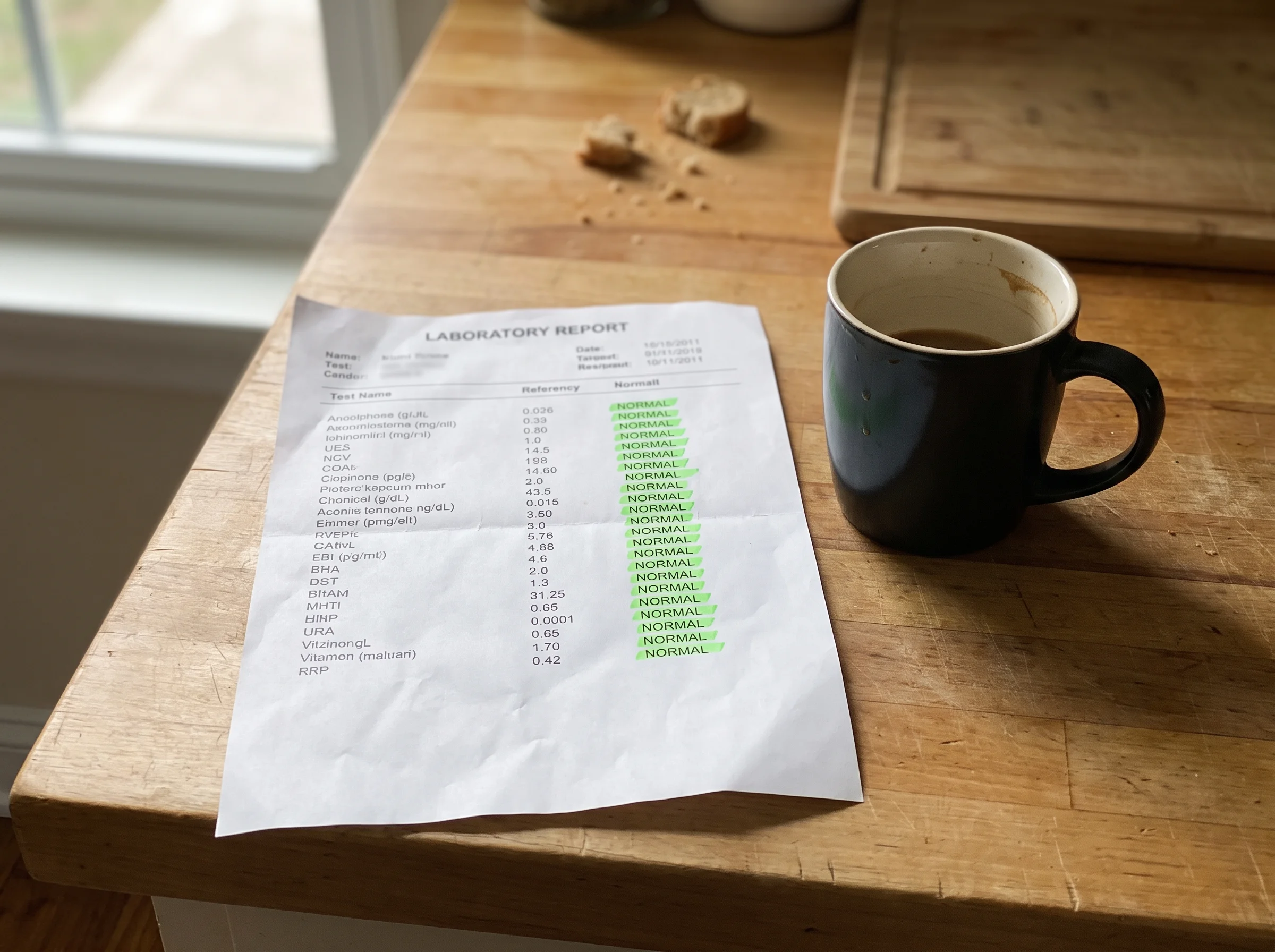
Last month your labs came back "normal." Your doctor said the word every guy over 45 has learned to hate. Aging. Come back in a year, watch your cholesterol, get more exercise. You paid the copay, walked out to your truck, and sat in the parking lot for a minute because you didn't know what else to do.
You know that flat Tuesday afternoon feeling that has nothing to do with the meeting? Yeah. Me too. I want to talk about what's actually happening, because "aging" is not an answer, it's a shrug. And most nutritional deficiencies in men over 45 never show up on the panel your doctor ran.
Normal Labs, Empty Tank
Here's the gap nobody in a white coat has said out loud to you: "clinically normal" and "actually alive" are two different addresses.
The standard panel your doctor ran is designed to catch disease. Not to measure whether you feel like a man. It's a floor, not a ceiling. You can be miles above the floor and still be running your house on half power, which is exactly where most men in their late 40s and 50s live.
That 3pm crash you feel? It's not in your head. There's a documented mid-afternoon dip in alertness and performance built into the human circadian clock. It shows up even in people who skip lunch, so it's not just the sandwich making you sleepy. It's a real thing, measured in real labs, in real men. [1] Read that sentence again. You're not weak. You're not lazy. You're not "just getting old at 3pm every day." You're feeling something science already put a name on.
Now stack another physiology fact on top of that. The cellular machinery that actually makes your energy, the mitochondria in your muscle, produces measurably less ATP with age. One study of adults from 18 to 89 clocked the decline at roughly 8 percent per decade. [2] That's not "you're broken." That's "the engine gets less efficient, so what you feed it matters more at 51 than it did at 31."
Your labs missed all of this because your labs weren't looking for it. And the food you've been eating, the "clean" plate you feel virtuous about, is probably missing exactly what would have covered it.
The House Running on a Bad Electrical Panel
Here's the picture I want you to hold in your head for the rest of this article.
You think a breaker is tripped. One thing is off. If you could just figure out which one, you'd flip it back and everything would work again. So you buy a multivitamin. You add a greens powder. You start doing more cardio. Nothing moves.
That's because it isn't one breaker. Five breakers are stuck at 60 percent. Every appliance in the house is running dim. The fridge hums a little quieter. The lights flicker at night. The AC struggles on a hot day. You keep replacing bulbs and wondering why the room still looks gray.
Middle-aged men are rarely deficient in one thing. They're low-normal in a stack of things at once. That's why the labs look "fine" (each single number squeaks above the deficiency floor) and you still feel like hell (five signals together add up to a systems failure).
You don't have a bulb problem. You have a panel problem. The rest of this piece is about what's on the panel and how it got that way.
The Five Quiet Nutritional Deficiencies in Men
I'm going to name five. I'm going to go deep on the ones most articles skip, and short on the ones you've heard about a thousand times. The point is the pattern, not the checklist.
1. Choline (the one nobody names)
Choline is an essential nutrient. That word matters. It means your body needs it from food and cannot make enough on its own. It's used to build cell membranes, move fat around your body, and make acetylcholine, the signaling molecule your brain uses for memory and focus.
Here's where it gets interesting. In a controlled study where healthy adults were put on a severe choline restriction, 77 percent of the men developed reversible signs of liver or muscle dysfunction. [3] Seventy-seven. That's not a fringe finding. That's a red flag saying men are especially vulnerable when choline runs low.
And here's the observational nod: in the Framingham Offspring cohort, higher dietary choline was associated with better verbal and visual memory scores and fewer white-matter lesions on brain scans. [4] Association only. Not a promise. But it tells you the direction things point.
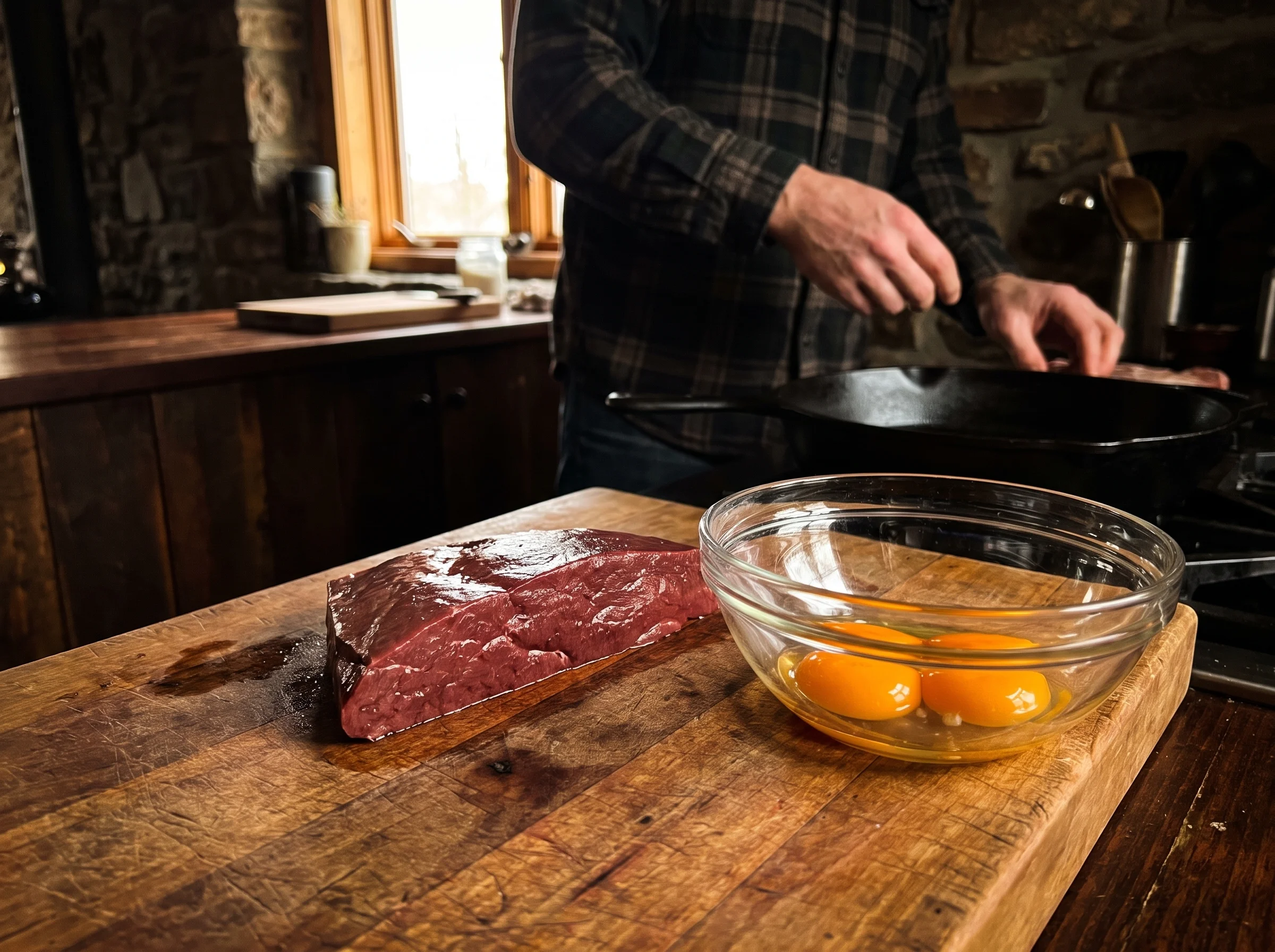
Now the punchline. Where's choline in food? Egg yolks, sure. And beef liver, which carries roughly 330 mg of choline per 100 grams. [5] That's a whole-food dose most Americans get zero of, because we quietly stopped eating liver about three generations ago.
Think of choline like the insulation on the wiring in your house. When it thins out, the signals still travel, they just get noisy. You forget the guy's name at the barbecue. You lose the word mid-sentence. You reread the same paragraph three times.
Nobody told you about choline. That's mistake number one on the panel.
2. CoQ10 (heart, energy, and the cooking problem)
Coenzyme Q10 lives inside the inner membrane of your mitochondria. In plain English, it's part of the machinery that turns the food you eat into the energy your body actually uses. It also works as an antioxidant. And CoQ10 levels decline in some tissues as men age. [6]
Where does the body keep the most CoQ10? Heart muscle. Because heart muscle never gets to take a break, and running never-stop tissue takes a mountain of ATP.
So what's the richest food source of CoQ10? Beef heart. In a nutrient analysis, raw beef heart carried about 11 mg per 100g, more than liver or ordinary muscle meat. [7] That's the food-side symmetry that ancestral cultures didn't need a study to figure out. Eat the strong parts of a strong animal.
Here's the braingasm. The same study measured what happens when you cook heart the way most Americans would cook it. Frying dropped recoverable CoQ10 to roughly 69 percent. [7] So even the rare "I eat heart" guy is losing about a third of the very thing that made heart worth eating in the first place. Heat is the tax.
Think of CoQ10 like the charger for the batteries in every cell. When the charger wears down, everything in the house runs at half power. That's not aging in the poetic sense. That's a supply problem with a specific molecule.
3. Preformed Vitamin A (the conversion gamble)
Vitamin A is involved in immune function, cellular communication, growth, vision, and male and female reproduction. [8] That's not a small job list. That's a "your body needs this or the wheels come off" nutrient.
Here's what almost no men's-health article will tell you. Vitamin A comes in two forms: preformed retinol (from animal foods) and beta-carotene (from plants, like carrots and sweet potatoes). Your body has to convert beta-carotene into retinol to use it. And that conversion is inefficient and varies wildly between people, roughly 4 to 1 up to 28 to 1 by weight. [9] Meaning: it can take up to 28 grams of beta-carotene to yield 1 gram of retinol, depending on your genes, your gut, and what else is on your plate.
You thought the carrots covered it. They might. They also might not. Your genes decide, and you were never told to check.
Beef liver, on the other hand, delivers preformed retinol. No conversion. No coin flip. That's why liver is called "nature's multivitamin," and also why we ate it for a hundred thousand years and stopped in a single generation.
I'm not telling you retinol is a magic bullet. Liver is very concentrated, and you can absolutely overdo it with straight liver. I'm telling you the plant-only route is a bet you probably didn't know you were placing.

4. Zinc (short version)
Zinc is essential for reproductive development and function. Zinc deficiency causes hypogonadism and impaired immune function. [10] If you're low, the dominoes fall in a lot of directions.
I'm not going to overclaim here. Zinc doesn't magically change hormones in men who already have enough. But zinc is one of those minerals that low-normal Americans routinely run underfed on, especially guys eating chicken breast and rice and not much red meat or shellfish.
Beef organs, especially prostate and testicle tissue, carry zinc alongside other minerals in a whole-food matrix. That's the pattern, not a pill.
5. B12 and Iron (the honest short version)
B12 is required for red blood cell formation, neurological function, and energy metabolism. Deficiency causes fatigue and a specific kind of anemia. [11] Here's the part I'm going to say plainly because most supplement companies won't: B12 supplementation does not improve energy or performance in people who are not deficient. If you're replete, more B12 does nothing.
Same story with iron. Iron deficiency, especially in adults with low stores, can produce measurable fatigue that iron replacement reduces. [12] But if your ferritin is fine, more iron isn't your lever. And a small but important caveat: men with hemochromatosis, high ferritin, or medical advice to limit iron should talk to their doctor before adding an iron-containing organ product. Iron is not a "more is better" mineral for men.
I mention B12 and iron because they're on every men's-health listicle, and because the honest framing matters. The panel-fix is not "swallow more of everything." It's "put the whole food back on the plate and let the body sort it."
Why "Eating Healthy" Missed All of This
Now the part that stings.
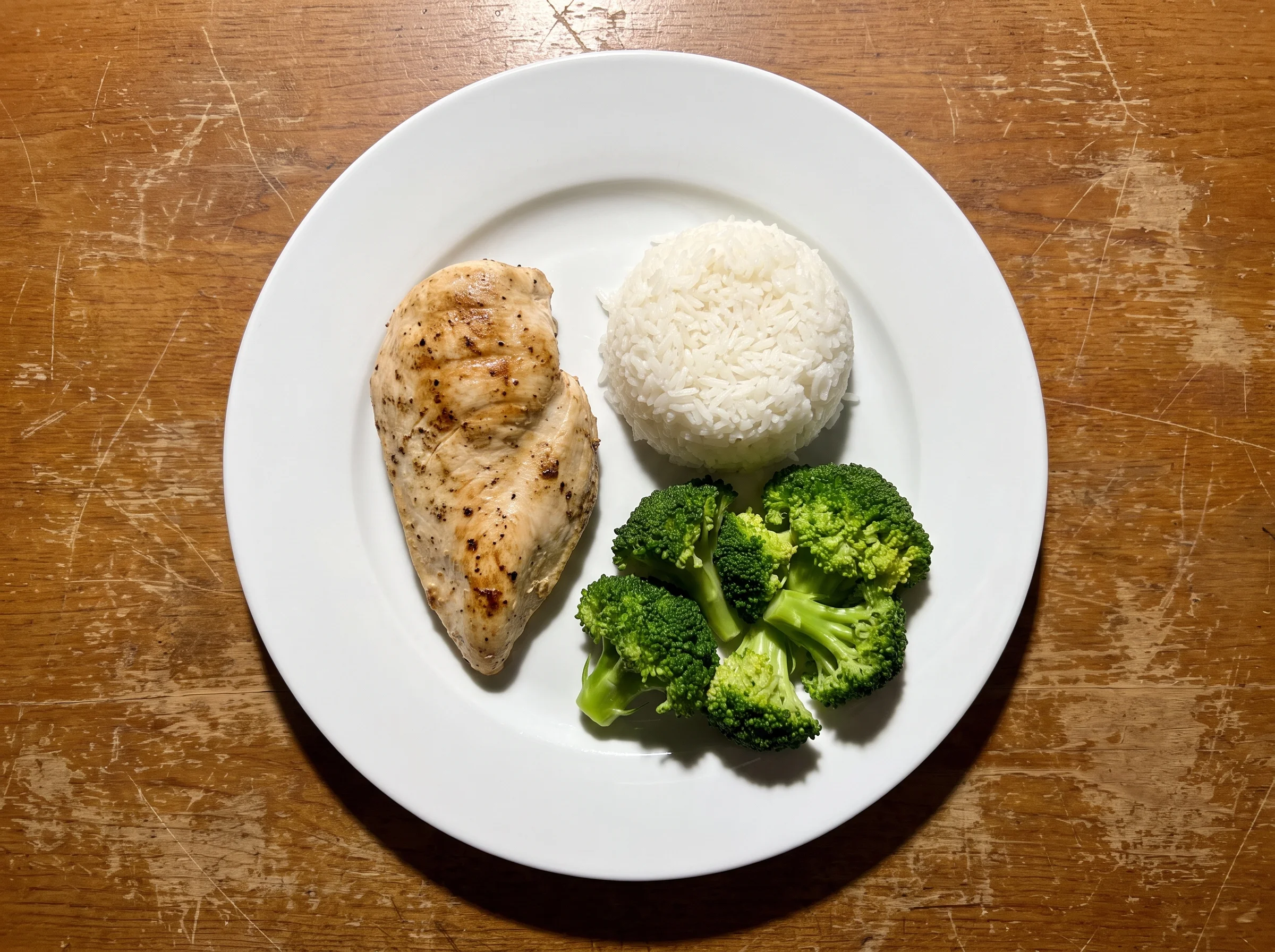
You've been eating what every magazine, doctor, and trainer told you was a clean diet. Grilled chicken. Rice. Broccoli. Protein shake. Salad at lunch. Maybe salmon on Sunday. That plate is a fine floor. It won't kill you. It also happens to be missing every single thing I just walked you through.
A 2024 analysis of raw United States beef offal confirmed what our great-grandparents ate on instinct: liver, heart, and kidney carry distinct, complementary micronutrient loads that muscle meat simply does not. Liver especially high in preformed vitamin A, B12, riboflavin, copper, and iron. Heart and kidney bringing their own concentrated strengths. [13] USDA's own database backs it up, with kidney standing out as a notably rich source of selenium. [14]
You've been eating the leftovers of the animal your ancestors would have handed to the dogs. The parts that carried the real nutrient load, they threw those away in the last century because they got rich enough to prefer muscle meat. That's the whole story.
And here's the cooking problem stacked on top of the plate problem. Even if you did eat liver once a month, broiling it loses about 41 percent of its folate and frying loses about 50 percent. [15] The pan is a tax collector. Every time you turn up the heat, the frailer nutrients pay.
So the multivitamin didn't work because it's isolated synthetic nutrients in a matrix your body doesn't recognize. The greens powder didn't work because it's plants, and it can't hand you preformed retinol or CoQ10 or B12. The "eat cleaner" advice didn't work because clean was chicken and broccoli, and clean forgot organs.
You didn't fail. You followed the map they gave you. The map was missing the neighborhood.
Sleep, the Multiplier You Cannot Skip
I'm going to say this once and I'm going to say it hard.
If you're sleeping five or six hours a night, no nutrient stack on earth will bail you out. Not organs. Not a multivitamin. Not TRT. Not creatine. None of it.
In a controlled study of healthy young men, restricting sleep to about 5 hours per night for one week dropped daytime testosterone by 10 to 15 percent. [16] That was young men. If a 22-year-old's engine coughs on 5 hours, what do you think 5 hours is doing to yours at 52?
And sleep deprivation raises baseline cortisol and the cortisol response to stress. [17] Higher cortisol means more belly fat, more anxiety, worse recovery, more junk-food cravings at 9pm. It compounds every deficiency you have.
Seven hours minimum. Non-negotiable. If you fix nothing else this year and just start sleeping seven hours, you'll feel more different than any supplement will ever make you feel. The rest of what I'm about to tell you sits on top of sleep. It does not replace sleep.
You already knew this. I'm just the guy in the parking lot saying it to your face.
The Ancestral Answer
Here's where I got to in my own story. I was 48. I ate what I thought was well: chicken, rice, salad, protein shake, some fish. My labs were "fine." I was slowly leaking energy every month. One Tuesday at 3pm I put my head on my desk and could not remember the last time I felt like a person.
I started reading. Not blogs. Actual papers. Then I started asking a different question. Not "what am I deficient in." I asked "what did my great-grandfather eat that I don't?"
My great-grandfather ate liver, kidney, marrow, tongue. Not because he read a substack about ancestral eating. Because meat cost real money and you didn't throw any of it out. The organ meats went first, because they were the most valuable. The muscle meat, the stuff we now grill and call the good part, was the leftover.
We inverted the plate in one century. And then we couldn't figure out why the men were tired.
I tried to eat liver once a week for a month. Made it three weeks. On the third one I gagged over the sink and called my wife into the kitchen and told her I was done. Liver is nature's multivitamin. It also tastes like it lost a fight. There is not enough ketchup in the world to make me eat it every day.

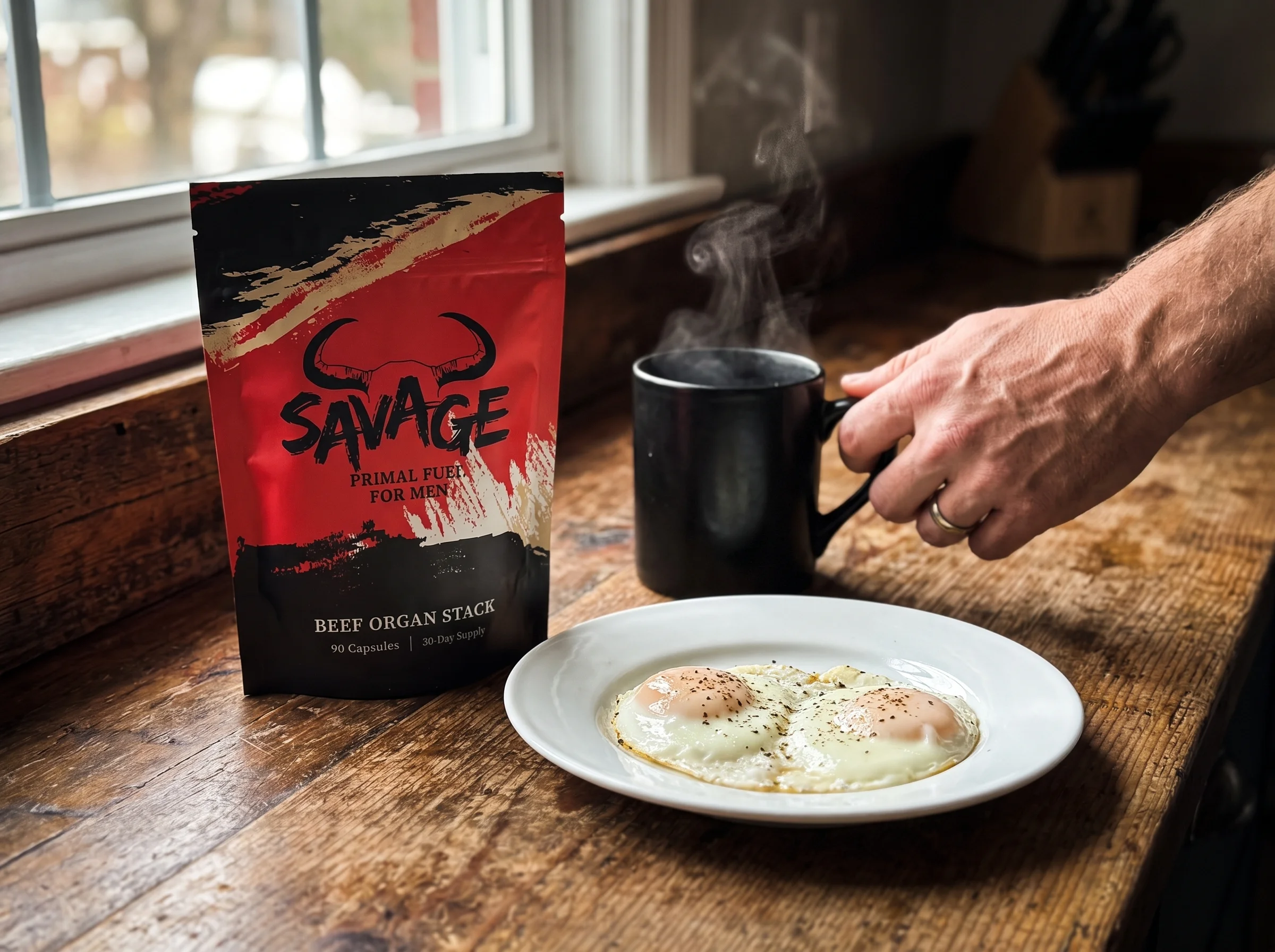
That's how I found the Savage Beef Organ Stack. It's three capsules with breakfast. Six organs: liver, heart, kidney, testicle, prostate, pituitary. Grass-fed, pasture-raised, USA-sourced, freeze-dried raw. The men I coach couldn't stomach organs every day, and neither could I. The Stack closes the gap between "I know I should eat organs" and "I actually will." That's the whole commercial reason it exists, and I'm going to say it plainly instead of pretending liver tastes like ribeye.
Two quick things on the process, because you should know. Freeze-drying (lyophilization) removes water at low temperature under vacuum, which preserves heat-sensitive quality better than the hot-air drying most cheap organ powders use. [18] And it avoids the sustained cooking heat that costs you almost half the folate in liver [15] and roughly a third of the CoQ10 in fried heart. [7] It's not "100 percent of nutrients locked in," I'm not going to lie to you. It's a better preservation method for fragile compounds than throwing organs in a pan.
Structure and function, staying honest: the Stack supports energy, recovery, hormonal balance, and male vitality. Not a boost. Not a cure. Root-cause micronutrient support in a form the body recognizes because we evolved eating it.
What To Actually Do This Week
I'm going to keep this short because you don't need ten habits. You need three levers.
1. Sleep seven hours. Non-negotiable. Move the phone. Move the alarm. Move the bedtime. If you're sleeping five, this is the first move, not the last one. Every other lever multiplies off this one.
2. Put organs back on your plate. Real ones if you can stomach them, once or twice a week. If you can't (which is most of us), the Savage Beef Organ Stack is three capsules with breakfast. Either way, the raw material starts showing up on the panel.
3. Lift heavy twice a week and hit your protein. Testosterone acutely rises after heavy resistance exercise in men. [19] The muscle response to training and protein tops out around 1.6 grams per kilogram per day, and older adults do better in the 1.0 to 1.2 range as a floor, more if you're training. [20] [21] Organs cover the micronutrients. Steak, eggs, and fish cover the protein. Lifting turns the raw material into a body that works.
That's it. Not ten habits. Three levers. Do them for 90 days before you evaluate.
The Bottom Line
The 3pm wall is real. The flat mornings are real. The gut in the mirror is real. You're not making it up, and you're not falling apart.
You're running four cylinders on an eight-cylinder demand, because the food that used to fuel a man like you left the American plate a hundred years ago. Your labs missed it because your labs weren't looking for it. Your doctor missed it because he was trained to catch disease, not depletion. The multivitamin missed it because a tablet of isolated nutrients is not the same food your body evolved on.
The fix is not new. It's very old. Put the whole animal back on the plate. Sleep like your life depends on it. Lift something heavy twice a week. Feed the raw material back into the panel, and see what breakers come back online.
I'm not promising you'll feel 25 again. I'm telling you what worked for me and for the men I coach, in the order it worked, without pretending anything tastes like something it doesn't.
Somewhere in the next couple of months, on a Tuesday you weren't expecting, you'll wake up at 5:30 before the alarm. You'll swing your legs off the bed and stand up without the internal negotiation. And you'll walk into the kitchen and think, huh. There he is.
That's the goal. That's the guy your family needs back. And he's not gone. He's just been eating the wrong parts of the animal.
FAQ
Q: Why do I feel tired all the time when my labs are "normal"?
Because standard labs measure single nutrients against a floor set by disease prevention, not by thriving. You can be above every red line and still be low-normal on five things at once. The panel doesn't measure that pattern.
Q: Isn't this just aging?
Some of it, yes. Mitochondrial energy production declines with age. [2] Testosterone slowly falls with age in healthy men. [22] But "aging" is a description, not a cause. What accelerates it is sleep debt, missing micronutrients, no training, and a plate that skips the parts of the animal your ancestors ate. Fix those and you don't stop aging. You just stop leaking as fast.
Q: Can't I just take a multivitamin?
You can, and it won't hurt most guys. It probably won't move much either. A multivitamin is isolated synthetic nutrients in a matrix your body didn't evolve on. Whole-food organ nutrition delivers vitamins, minerals, and cofactors in the ratios they naturally occur, alongside compounds like CoQ10 and choline that most multis are short on or don't include at meaningful levels.
Q: I don't want to go on TRT for the rest of my life. Am I stuck?
You're not stuck. Sleep, training, and food fix a bigger share of what most middle-aged men are calling "low T" than most guys realize. This isn't anti-medicine. It's pro-ownership. Try the root-cause levers for 90 days before you sign up for something you never get off of.
Q: Is the Savage Beef Organ Stack safe if I already have high ferritin?
Iron-containing organ products aren't ideal for men with hemochromatosis, high ferritin, or medical advice to limit iron. Talk to your doctor first. That's an honest caveat, not a scare tactic.
References
[1] Monk TH. The Post-Lunch Dip in Performance. Clin Sports Med. 2005;24(2):e15-e23. https://pubmed.ncbi.nlm.nih.gov/15892914/
[2] Short KR, et al. Decline in skeletal muscle mitochondrial function with aging in humans. PNAS. 2005;102(15):5618-5623. https://pubmed.ncbi.nlm.nih.gov/15800038/
[3] Fischer LM, et al. Sex and menopausal status influence human dietary requirements for the nutrient choline. Am J Clin Nutr. 2007;85(5):1275-1285. https://pubmed.ncbi.nlm.nih.gov/17490963/
[4] Poly C, et al. The relation of dietary choline to cognitive performance and white-matter hyperintensity in the Framingham Offspring Cohort. Am J Clin Nutr. 2011;94(6):1584-1591. https://pubmed.ncbi.nlm.nih.gov/22071706/
[5] USDA Database for the Choline Content of Common Foods, Release 2 (2008). https://www.ars.usda.gov/ARSUserFiles/80400525/data/choline/choln02.pdf
[6] Diaz-Casado ME, et al. The Paradox of Coenzyme Q10 in Aging. Nutrients. 2019;11(9):2221. https://pmc.ncbi.nlm.nih.gov/articles/PMC6770889/
[7] Ercan P, El SN. Changes in content of coenzyme Q10 in beef muscle, beef liver and beef heart with cooking and in vitro digestion. J Food Compost Anal. 2011;24(8):1136-1140. https://www.sciencedirect.com/science/article/pii/S0889157511001517
[8] NIH Office of Dietary Supplements, Vitamin A and Carotenoids Fact Sheet for Health Professionals. https://ods.od.nih.gov/factsheets/VitaminA-HealthProfessional/
[9] Tang G. Bioconversion of dietary provitamin A carotenoids to vitamin A in humans. Am J Clin Nutr. 2010;91(5):1468S-1473S. https://pubmed.ncbi.nlm.nih.gov/20200262/
[10] NIH Office of Dietary Supplements, Zinc Fact Sheet for Health Professionals. https://ods.od.nih.gov/factsheets/Zinc-HealthProfessional/
[11] NIH Office of Dietary Supplements, Vitamin B12 Fact Sheet for Health Professionals